A Tenth Part Tin
Copper alone is too soft to hold an edge. Add about a tenth part tin and it casts better, hardens under the hammer and takes a working edge — but copper and tin almost never occur in the same place, so the alloy could not exist without long-distance trade. The whole period follows from that inconvenience.
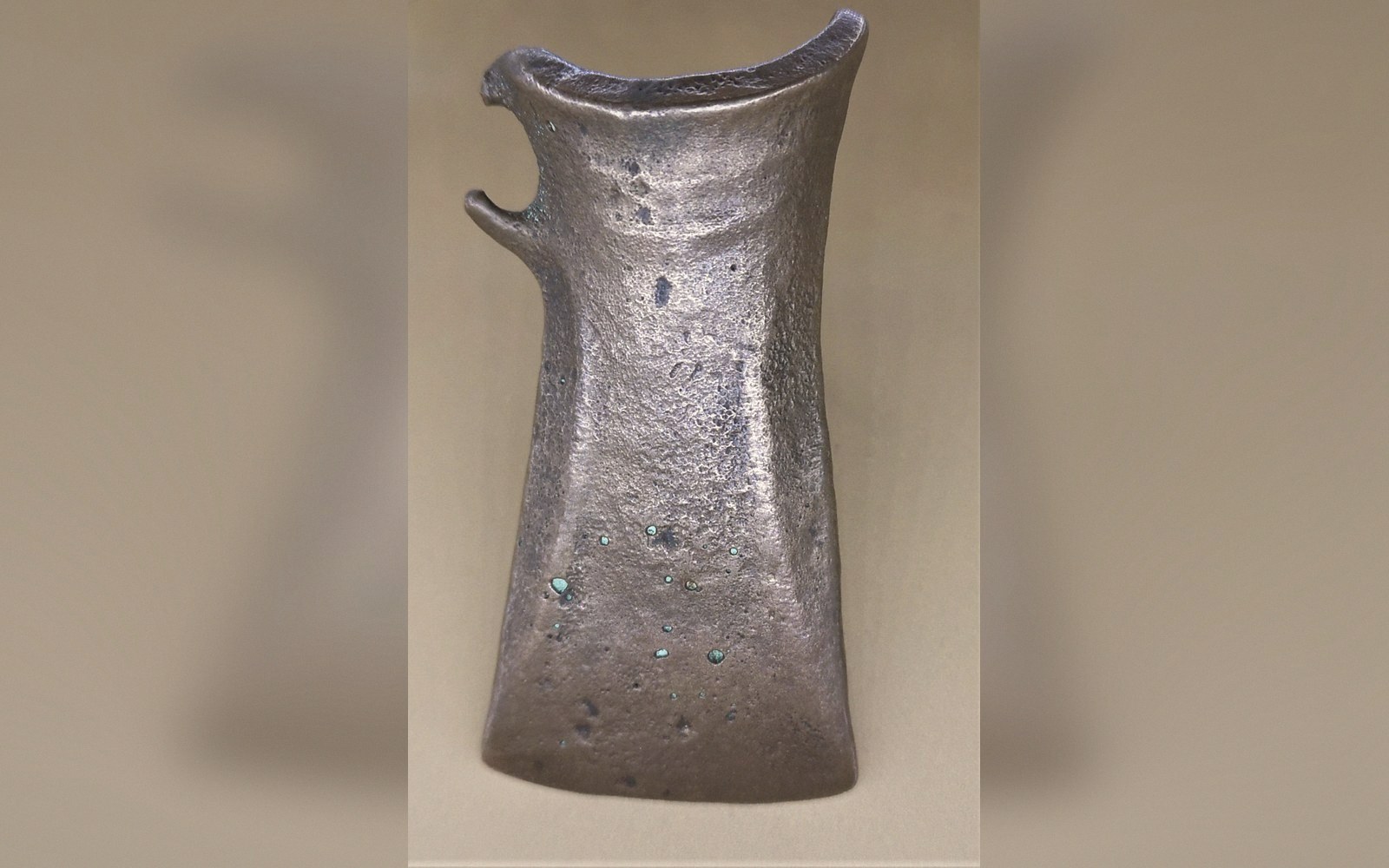
A socketed axe: the object type the alloy was made for, and the one that survives in the greatest numbers.
Photo: 020210904 Bronze Axe Head, Bronze Age, Lusatian culturearea in the Skawa River Basin, Andrychów · Wikimedia CommonsWhy the ratio matters
Copper smelted clean and poured into a mould produces a metal that looks the part but disappoints in use. It is soft enough to bend under sustained pressure, and an edge hammered into it blunts quickly against bone, wood or another blade. For most of the Chalcolithic — the copper-using period before the full Bronze Age — smiths worked with this limitation, producing tools and weapons whose performance was genuinely modest by the standards of what came next.
Add tin in roughly the right proportion and the metal transforms. An alloy running at around ten percent tin by weight casts more fluidly, fills a mould's detail more cleanly, and solidifies with a structure that responds to cold-hammering in ways that pure copper does not. The tin atoms sit in the copper crystal lattice and impede dislocation movement — the mechanism by which metal deforms plastically — so the alloy work-hardens faster and to a higher ceiling. A blade edge hammered cold becomes genuinely hard; a socketed axe finished the same way holds its shape under impact. The difference in performance between a copper tool and a well-made bronze one is not marginal. It is the difference between a functional weapon and a theatrical one.
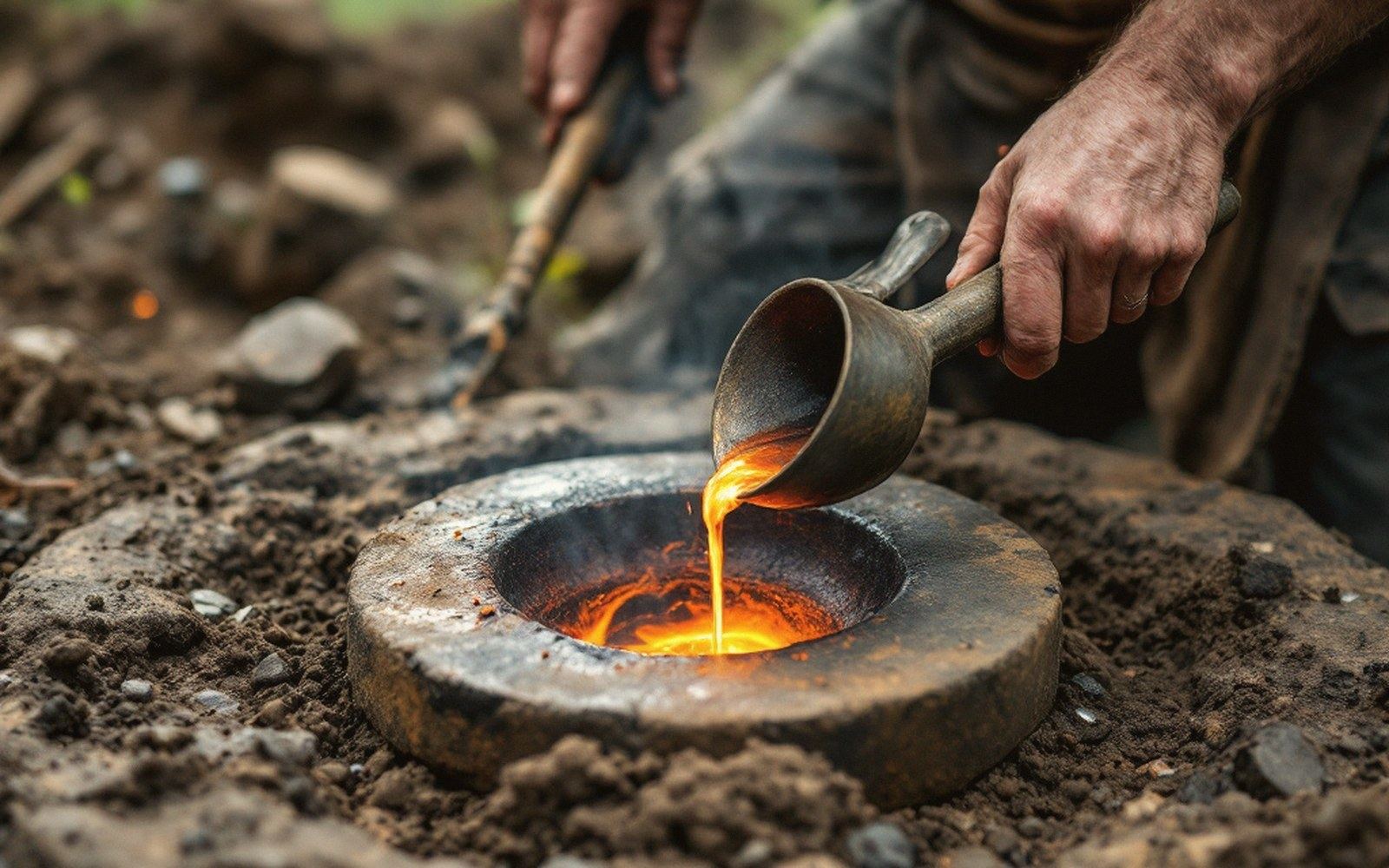
The pour cannot be paused, corrected or repeated. Everything before it is preparation for about twenty seconds of work.
The ten-percent figure is a rough centre, not a fixed prescription. Workshops varied. Some alloys ran leaner, around seven or eight percent, accepting a slightly softer product in exchange for greater ductility — useful for sheet metalwork. Others pushed higher, toward twelve or thirteen percent, chasing maximum hardness at the cost of brittleness. The proportion and hardness of any finished object reflects a decision, whether made consciously or through accumulated workshop habit, and the variation across a regional corpus often tracks object type rather than chance.
Chronology
- Chalcolithic (Copper Age)pre-bronze period when unalloyed copper dominated; third millennium BCE and earlier in much of Europe
- Early Bronze Agealloy becomes standard across Europe broadly from c. 2300–1800 BCE, region-dependent
- Middle and Late Bronze Agethe main period of large-scale bronze production and long-distance tin supply, c. 1600–800 BCE
What the alloy demanded
The irreducible problem is geology. Copper ore is reasonably widespread across Europe — the Alps, Iberia, the British uplands, the Carpathians and Cyprus all yield workable deposits — but tin, and its scarcity, is the stubborn constraint. Primary cassiterite, the principal tin mineral, occurs in economically useful concentrations in only a handful of places on the continent: the far north-west of Iberia, the uplands of Brittany, the south-western peninsula of Britain, and parts of central Europe, particularly the Erzgebirge along what is now the German-Czech border. Tin is not merely rare in the way that gold is rare; it is geographically concentrated to an unusual degree, and the regions that needed bronze overwhelmingly did not sit on top of any of it.
The consequence is that tin had to move. Isotope studies and trace-element analysis have made progress in linking tin in finished bronzes to probable source regions, though the method is still developing and many attributions remain provisional. What is not in doubt is the archaeological pattern: bronze appears and spreads across Europe during the second and third millennia BCE in a distribution that implies systematic, repeated supply across distances of several hundred kilometres, minimum. The alloy did not come from nowhere, and the regions that produced the best bronzes were not, as a rule, the regions that controlled the raw tin.
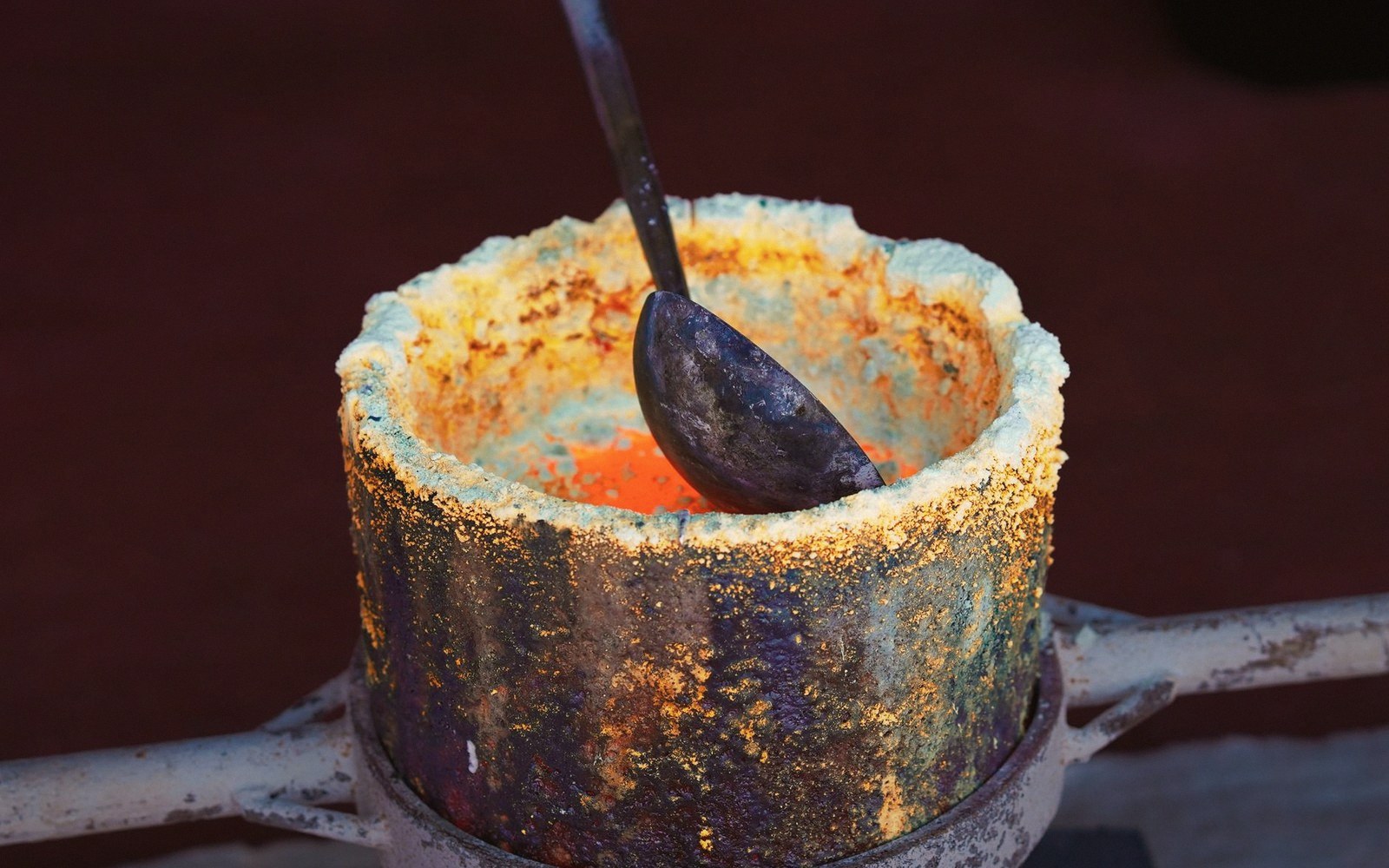
Charcoal, forced air and a crucible sitting in the fuel rather than above it.
Photo: Panta Singha / PexelsThis geographical inconvenience generated the infrastructure of the Bronze Age. Rivers were the main arteries; rivers shaped distribution far more than overland tracks, and the concentration of metalwork finds along navigable waterways reflects exactly this logic. Tin moved as ingots, copper moved as ingots, and finished bronze moved as objects, as scrap, and as broken metal destined for remelting. A hoard of fragmented axes and sword fragments is not a disaster or a loss — it is stock, valued by weight, waiting to become something else.
The alloy in numbers
Casting, hammering and the finished object
The practical chemistry of the alloy intersects with casting technology in ways that still show in the objects. Bronze with a higher tin content shrinks less on cooling than leaner alloys and picks up surface detail more faithfully — an advantage for complex moulds with pronounced ornament. The tin also lowers the melting point of the mixture relative to pure copper, which matters enormously when your heat source is a charcoal fire and a set of hand-operated bellows. The margins available to a Bronze Age smith were not large, and an alloy that behaved predictably in the mould, that did not develop excessive porosity or cold shuts, was worth a great deal. Smiths who could reliably hit the right ratio were doing something genuinely skilled.
After casting came finishing, and this is where much of the object's final character was set. The as-cast surface is rough and carries the flash of mould joins; the internal crystal structure is coarse. Hammering breaks up that coarse structure, introduces work-hardening, and drives out some of the shrinkage porosity. A cutting edge — on a sword, a chisel, a razor — received particular attention: careful, controlled hammering along the edge zone, annealing when the metal became too brittle to work further, then hammer again. The result is a hardness gradient across the object: the body tough and ductile, the edge hard and keen. Achieving this required knowledge that was not written down and could only be transmitted by watching someone who already had it.
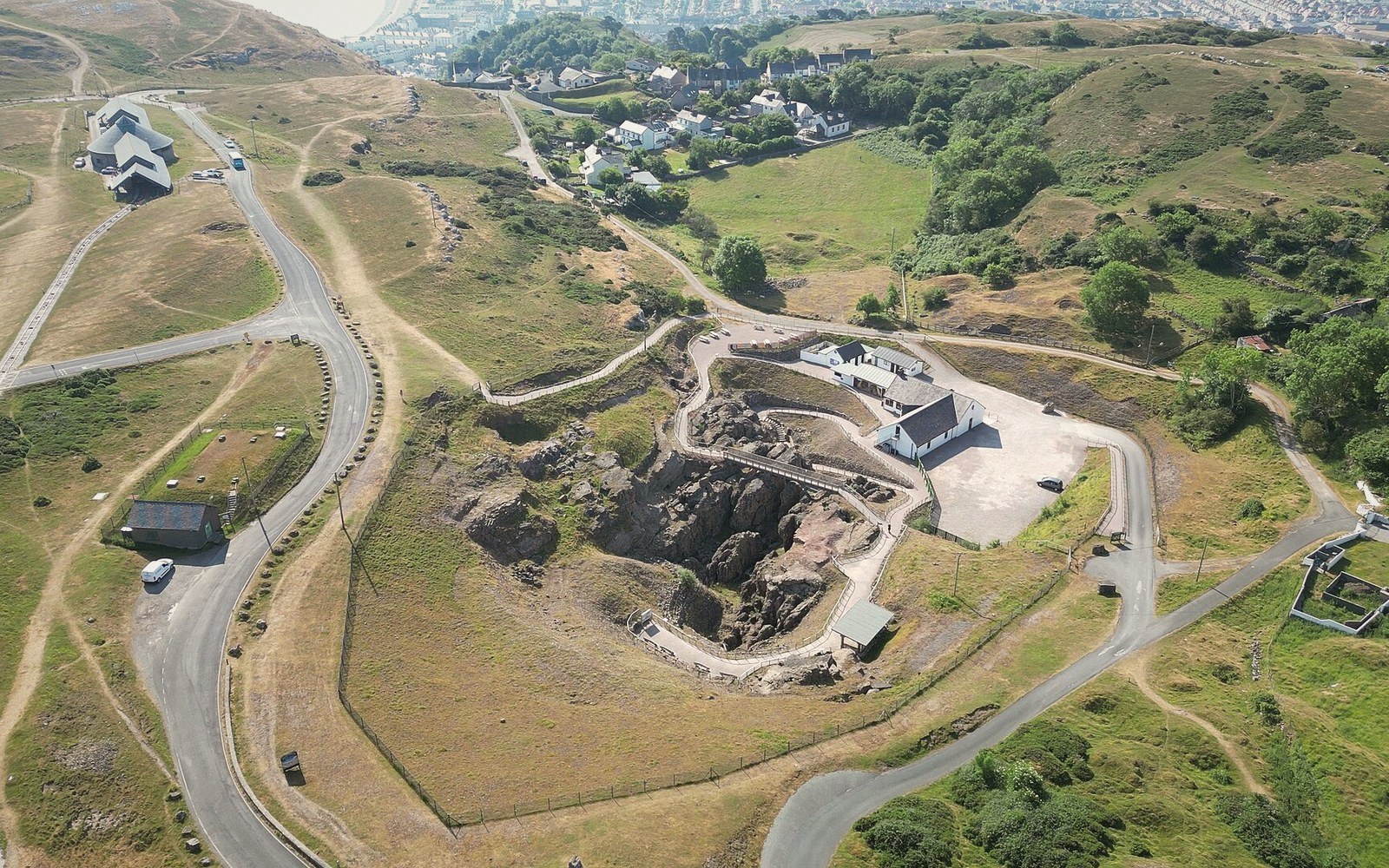 Plate iii
Great Orme, north Wales. Workable copper occurs across much of Europe; the spoil is often all that is left of the working.
Photo: Mwyngloddiau Copr y Gogarth - Great Orme Copper Mines; Mehefin - June 2023 01 · Wikimedia CommonsThe period it made possible
The ten-percent solution — approximate, variable, arrived at by experiment over generations — did more than improve cutting tools. It created a system. Because tin was scarce and geographically isolated, its movement required relationships: between communities that held the ore and communities that could smelt and smith it, between merchants or chiefs who organised transport, and between the specialists at each end of the chain. Control of that supply was, in a very direct sense, control of military capacity, and the social hierarchies visible in Bronze Age burial evidence are in part a reflection of who managed access to the alloy.
The ten-percent figure is a rough centre, not a fixed prescription.
The objects themselves — the swords, the axes, the palstaves, the rapiers and the socketed spearheads that fill museum cases from Lisbon to Warsaw — are the surviving end of a supply system that ran for over a millennium. Strip away the aesthetics and what remains is the residue of a mineral trade that connected places which had never needed to connect before, sustained by the simple, intractable fact that you cannot make the alloy without both metals, and they almost never occur together. The period follows from the inconvenience.