Bog finds
Anaerobic ground keeps organic material that survives nowhere else.
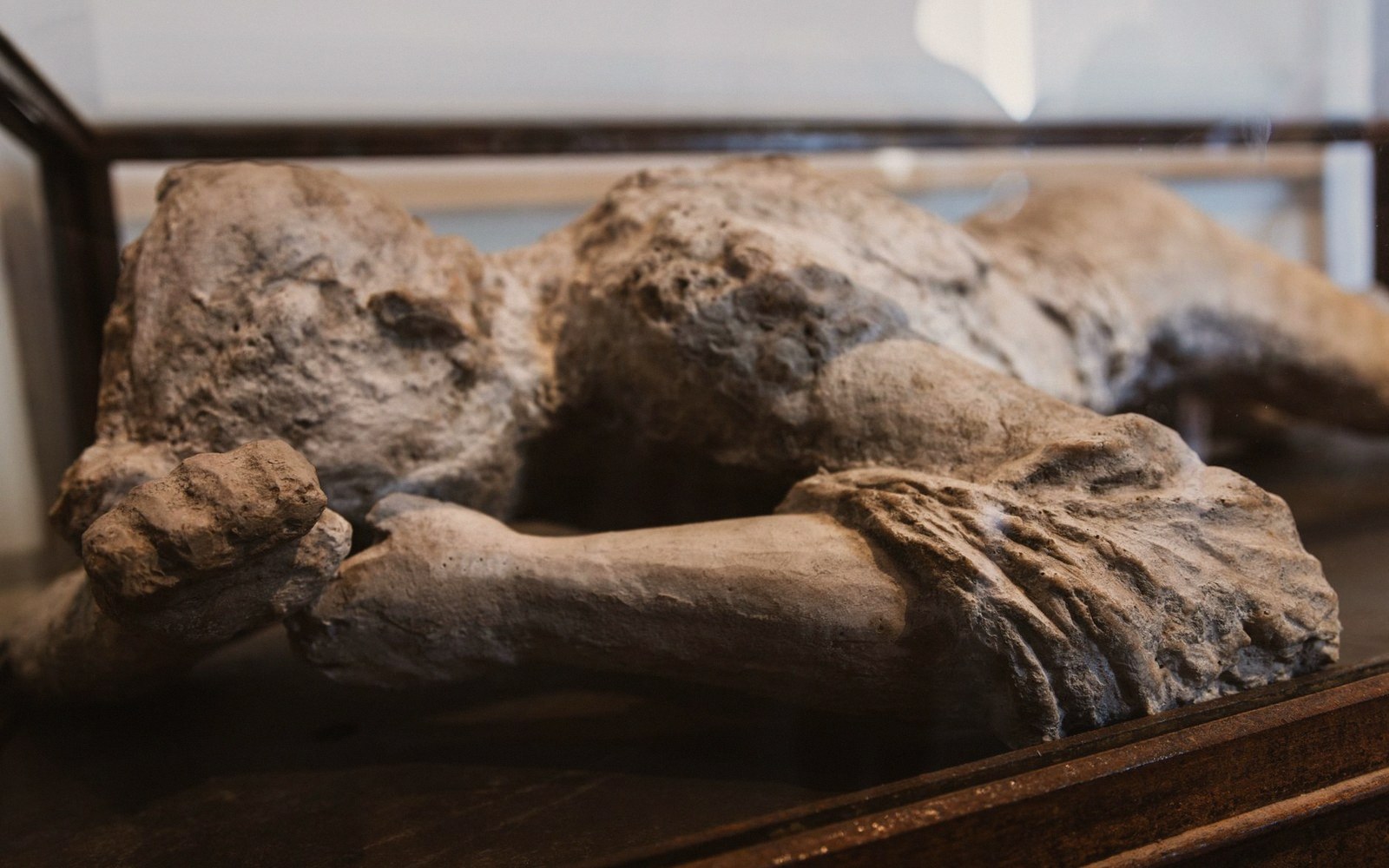
Peat holds organic material that survives nowhere else — leather, textile, cord, wood.
Photo: K / PexelsOrganic survival in anaerobic ground
Peat bogs are not kind to everything — iron rusts, bone can dissolve, ceramics survive on their own terms — but for organic material, particularly wood, textile, leather and human tissue, the conditions are extraordinary. The chemistry is simple: in deep, waterlogged peat, oxygen is almost entirely absent. Bacteria that break down organic matter need it. Without oxygen, decomposition stalls, sometimes for millennia.
The acidity of sphagnum-dominated bogs accelerates tanning of skin and suppresses microbial activity further. A body interred in a raised bog can emerge with fingerprints intact, stomach contents preserved, and facial hair still attached. A wooden handle wedged into peat in the Middle Bronze Age may still carry the tool facets left by the craftsman who shaped it. This is the record that mineral soil simply cannot provide, and it changes what we can say about everyday life and deliberate deposition in the European Bronze Age.
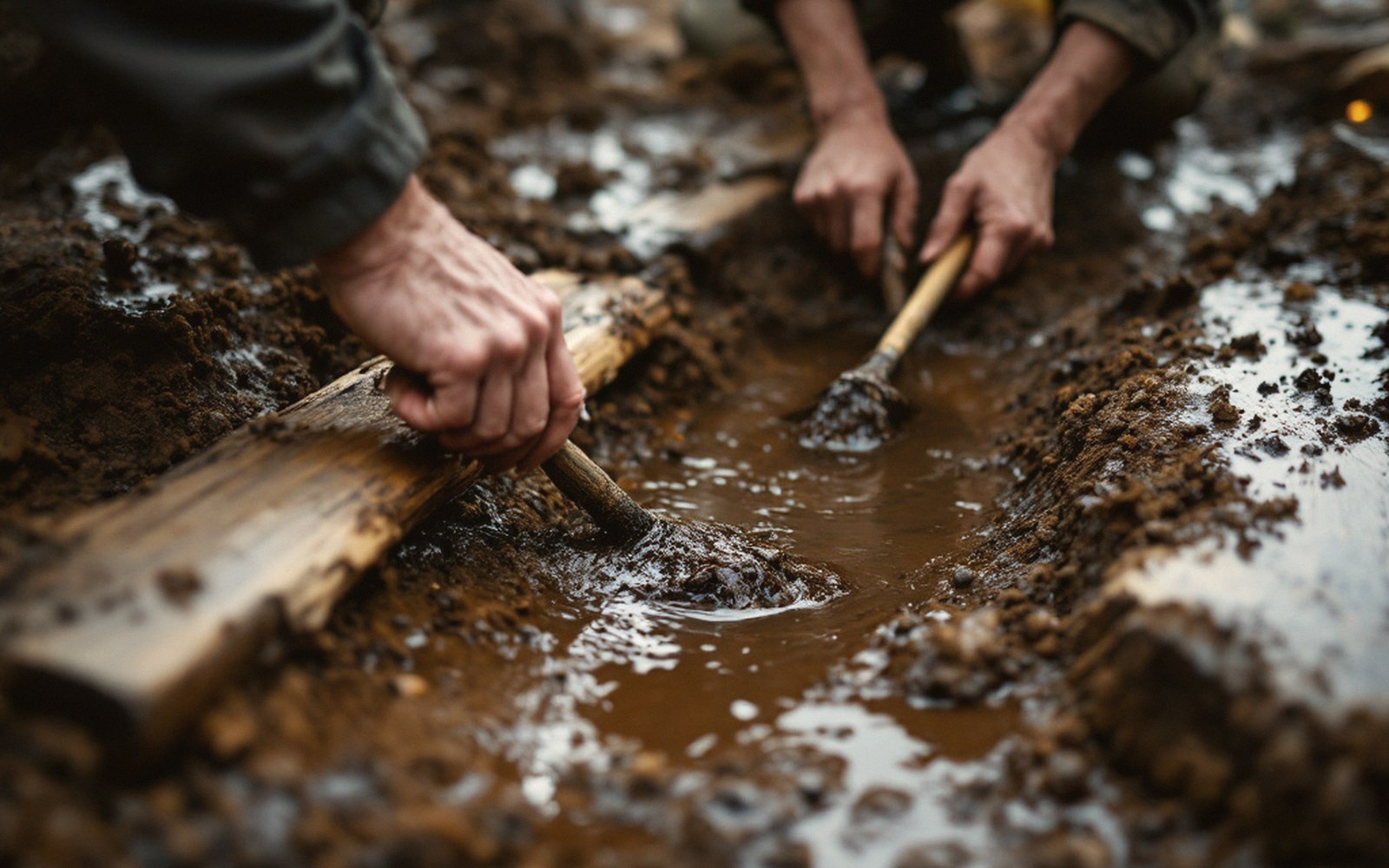
A trench in wet ground is pumped for as long as it stays open. The water that preserved everything also makes it hard to see.
What the peat preserves — and what it does not
For Bronze Age studies, the most significant bog finds are not bodies but metalwork, wooden objects, and textiles, each class telling a different story. Bronze weapons and tools are often recovered in excellent condition, protected from corrosion by the anoxic, acidic environment in a way that river silts or ploughsoil cannot match. Swords, spearheads, and socketed axes emerge with casting seams, cold-worked edges, and deliberate bending damage that might not survive centuries in aerated ground. That damage matters: objects bent or broken before deposition are distinguishable from accidental breakage, and bogs concentrate them.
Preservation conditions
| Item | What the record says |
|---|---|
| Anoxic | without free oxygen; the key condition that halts aerobic decomposition in waterlogged peat |
| Sphagnum bog | raised bog dominated by sphagnum moss, typically more acidic than fen peat; a better preserving environment for organic material |
| Tanning | the chemical transformation of protein in skin to a stable, decay-resistant form; in bogs, achieved by humic acids rather than human craft |
Wooden objects recovered from bogs include handles, hafts, buckets, and occasionally complete vehicles. The grain structure of waterlogged timber holds every cut and split; the edges of a Bronze Age hafted tool can still reveal which axe type felled it and at what angle. Textile survives in bogs at a rate utterly disproportionate to any other context. Woollen cloth preserved in Danish and northern German bogs has allowed researchers to reconstruct weaving techniques, thread count, and the use of plant-based dyes that leave no trace in mineral finds.
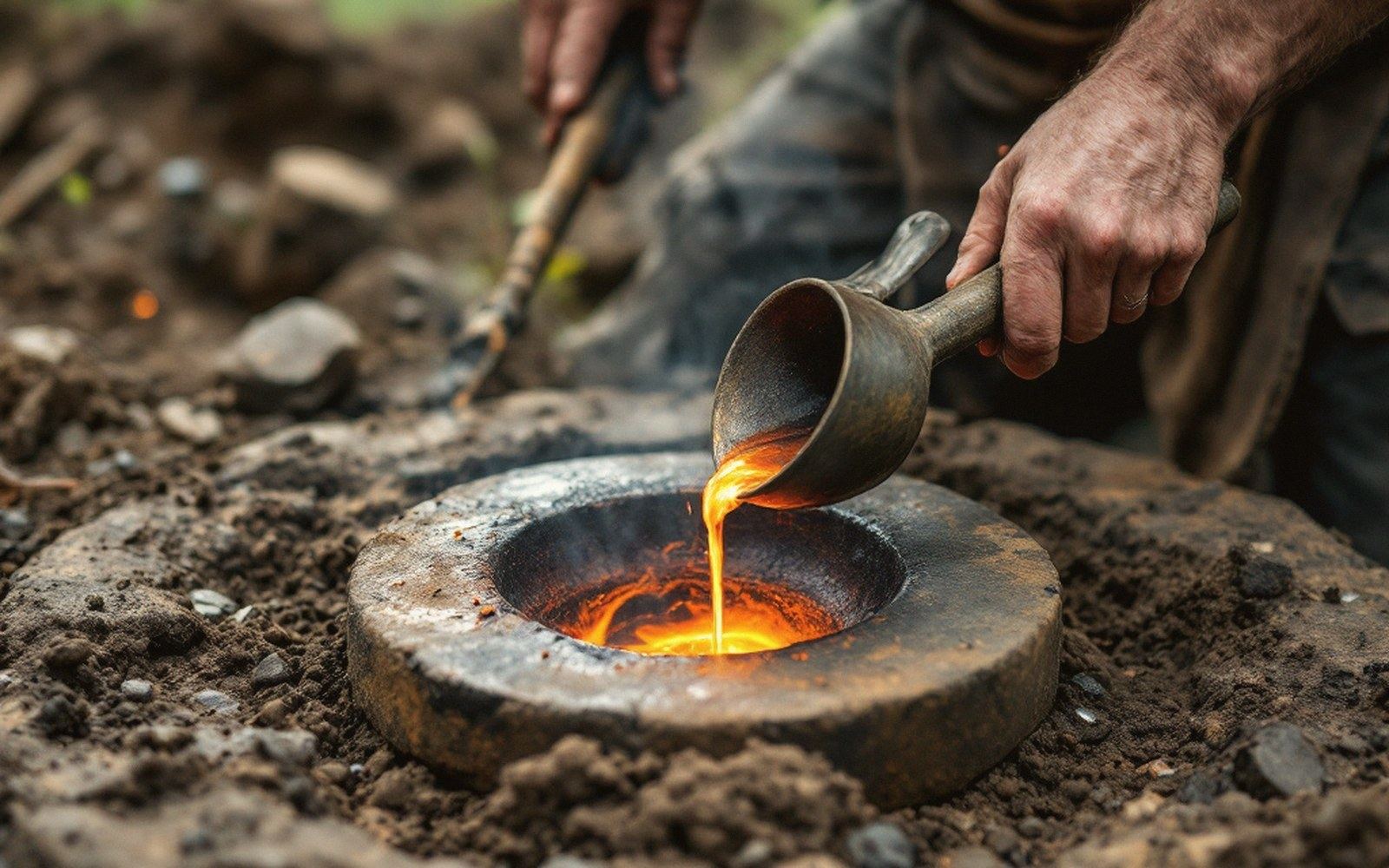
The pour cannot be paused, corrected or repeated. Everything before it is preparation for about twenty seconds of work.
Leatherwork — shoes, scabbards, bags — appears with the same fidelity. What bogs do not preserve well is anything that was already mineralised: pottery is chemically indifferent to the peat, surviving or not on its own structural merits, and most bone dissolves in acidic conditions unless particularly dense.
Interpretation: deliberate or lost?
The concentration of metalwork in bogs is not random. Distribution mapping consistently shows Bronze Age bronze accumulating in wetland margins and open water rather than scattered evenly across settlement landscapes. The interpretation — contested but gaining ground — is that much of this material was placed intentionally. Hoards recovered from bogs include complete and apparently functional objects, not only broken or worn-out pieces. Whether the act constituted offering, storage, or the permanent removal of politically loaded objects from circulation is a question the deposit itself cannot answer, but the patterning argues against accident.
Chronology of the deposit pattern
- Middle Bronze Age onwards: wooden hafts and handles recovered from bogs retain tool-mark evidence
- Multiple Bronze Age phases: metalwork at individual bog sites spans generations, implying repeated deliberate return
- Loss rate ongoing: drainage and peat cutting have removed large volumes of undisturbed archive since the post-medieval period
Bogs also preserve evidence of structured deposition over time. At some sites, metalwork of several successive phases has been recovered from a restricted area, implying repeated return to the same location across generations. That continuity suggests the place itself held significance, not merely the moment of deposit. The same logic applies to river metalwork: neither context looks like casual loss at scale.
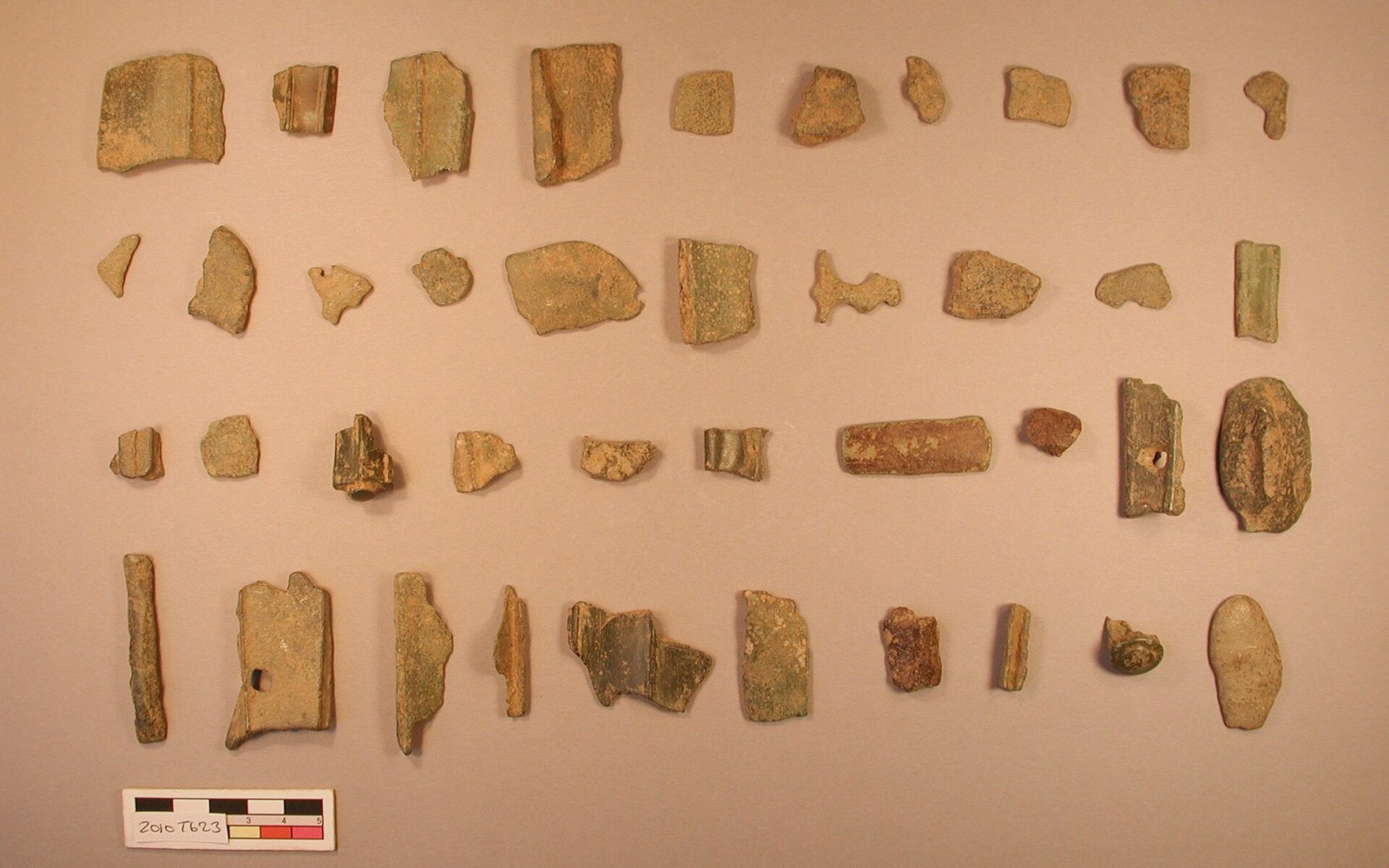 Plate iii
A hoard as it is usually met — laid out flat, its arrangement in the ground already lost.
Photo: Bronze Age hoard (FindID 411170) · Wikimedia CommonsWhat bogs add, which rivers cannot, is the organic accompaniment. A wooden platform, a plank, a textile wrapping — these can survive when the bog is deep enough and undisturbed. Where they appear alongside metalwork, they shift the interpretation from simple loss toward structured, deliberate action carried out in a place that was understood as liminal, between dry land and open water.
For Bronze Age studies, the most significant bog finds are not bodies but metalwork, wooden objects, and textiles, each class telling a different story.
The peat record is finite and fragile. Drainage agriculture, peat extraction, and climate-driven drying have destroyed enormous volumes of bog archive across northern and western Europe. What has been recovered represents a fraction of what once existed, which makes what survives — those fingerprints, those hafts, those bent swords — proportionally more significant with every year that passes.