Ingots and Scrap
Metal circulated as raw stock and as broken objects. A scrap hoard is a bank, not a loss.
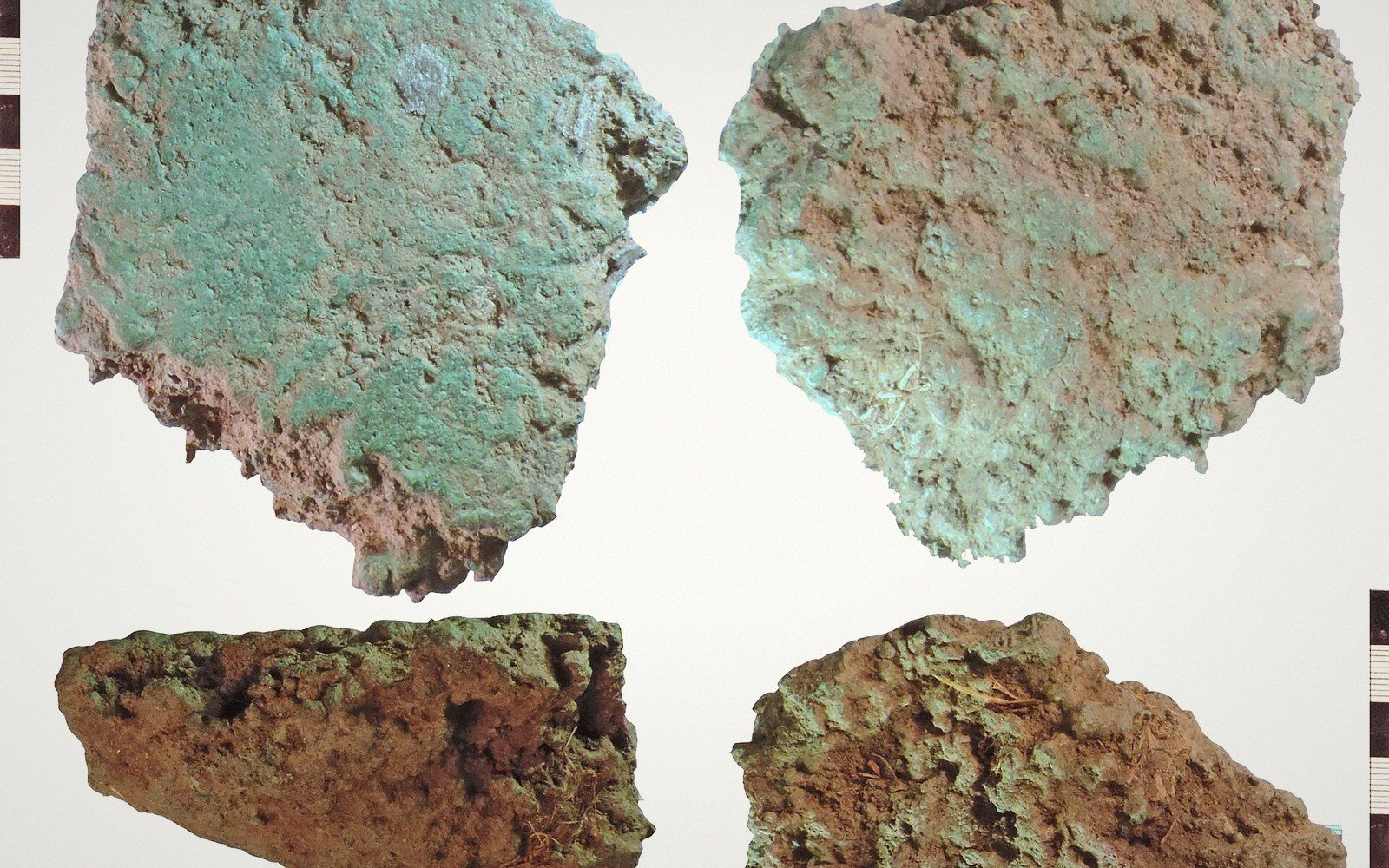
A copper-alloy ingot fragment. Stock circulated by weight, not as finished objects.
Photo: Undated Copper Alloy Ingot (FindID 877162) · Wikimedia CommonsThe metal that moved before it was anything
Raw bronze circulated across Bronze Age Europe in forms designed for the journey, not for the hand. The most recognisable is the ox-hide ingot — a large, roughly rectangular slab of copper with four concave sides that give it a distinctive notched silhouette, probably a practical shape for stacking or carrying across a back or a pack-frame rather than a formal tribute to the animal. Hundreds have been recovered from the eastern Mediterranean, most famously from the Uluburun shipwreck off southern Turkey, where they were stacked in rows in the hold alongside tin ingots and other cargo in the fourteenth century BC. Similar, if smaller, conventions appear further north and west: bun ingots (rounded, plano-convex loaves of copper), ring ingots, and the plano-convex cakes of tin that occasionally survive in European contexts. The shapes vary by region and period, but the principle is consistent — metal cast into a portable, recognisable form that declares its own nature and can be broken, weighed, and re-melted without ceremony.
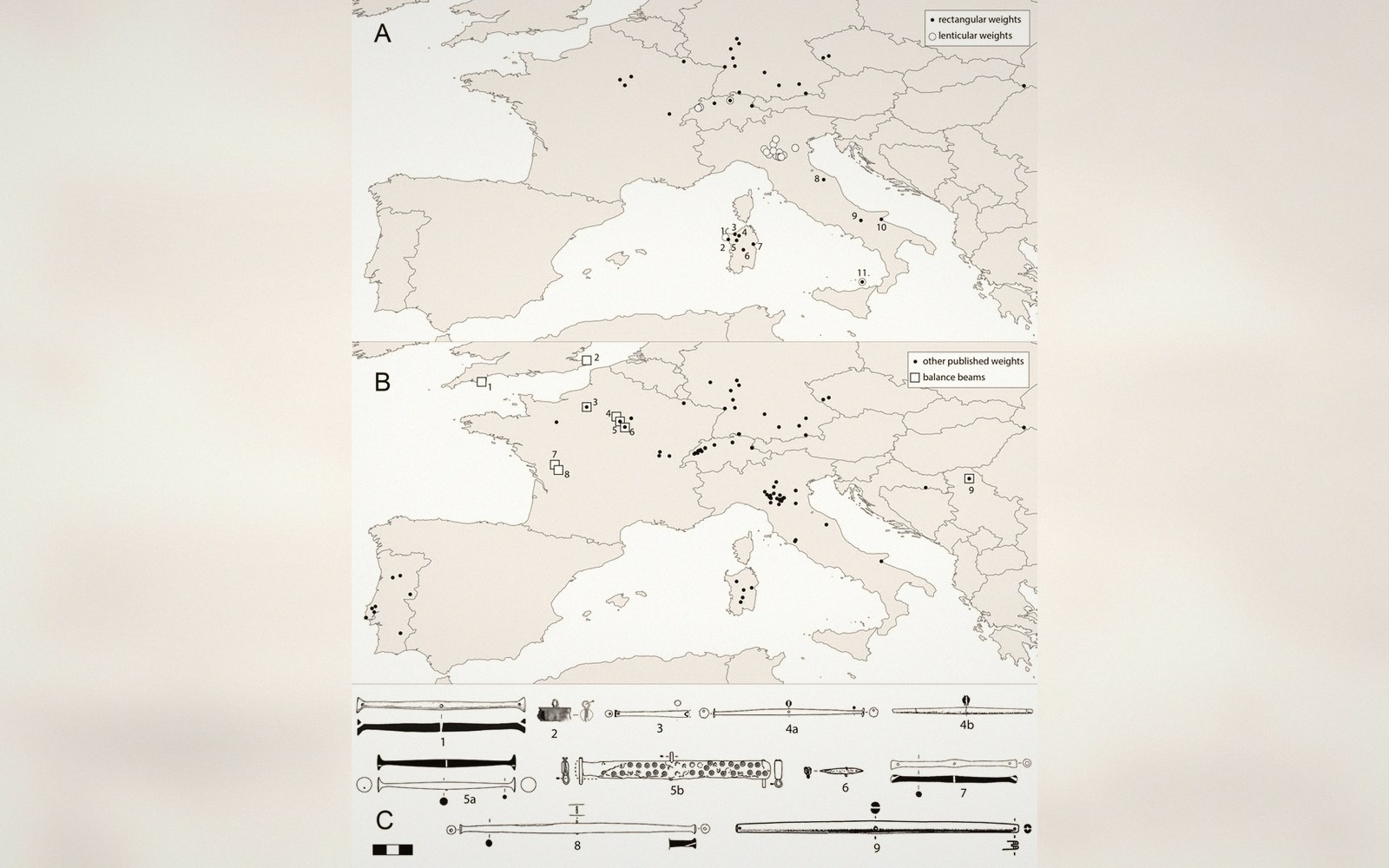 Plate iii
Distribution of balance beams and weights across Bronze Age Europe — the evidence that metal was reckoned by mass.
Photo: Distribution of weighing equipment in Bronze Age Europe · Wikimedia CommonsIngots are, strictly, a casting intermediary: the smelter's product, not the smith's. What the smith received was raw stock that had already crossed considerable distance. Copper sources in the Alps, on the Iberian Peninsula, in Wales and Ireland fed smelting sites whose output entered circulation as ingots. Tin and its scarcity meant that the tin component in particular had probably travelled far before it reached any workshop — Cornwall to Brittany, Erzgebirge to the Rhine, the evidence of distribution pointing consistently to long-distance movement by routes and rivers. What a smith actually used was often an alloy of uncertain prior history, received either as ingot or as something else altogether: scrap.
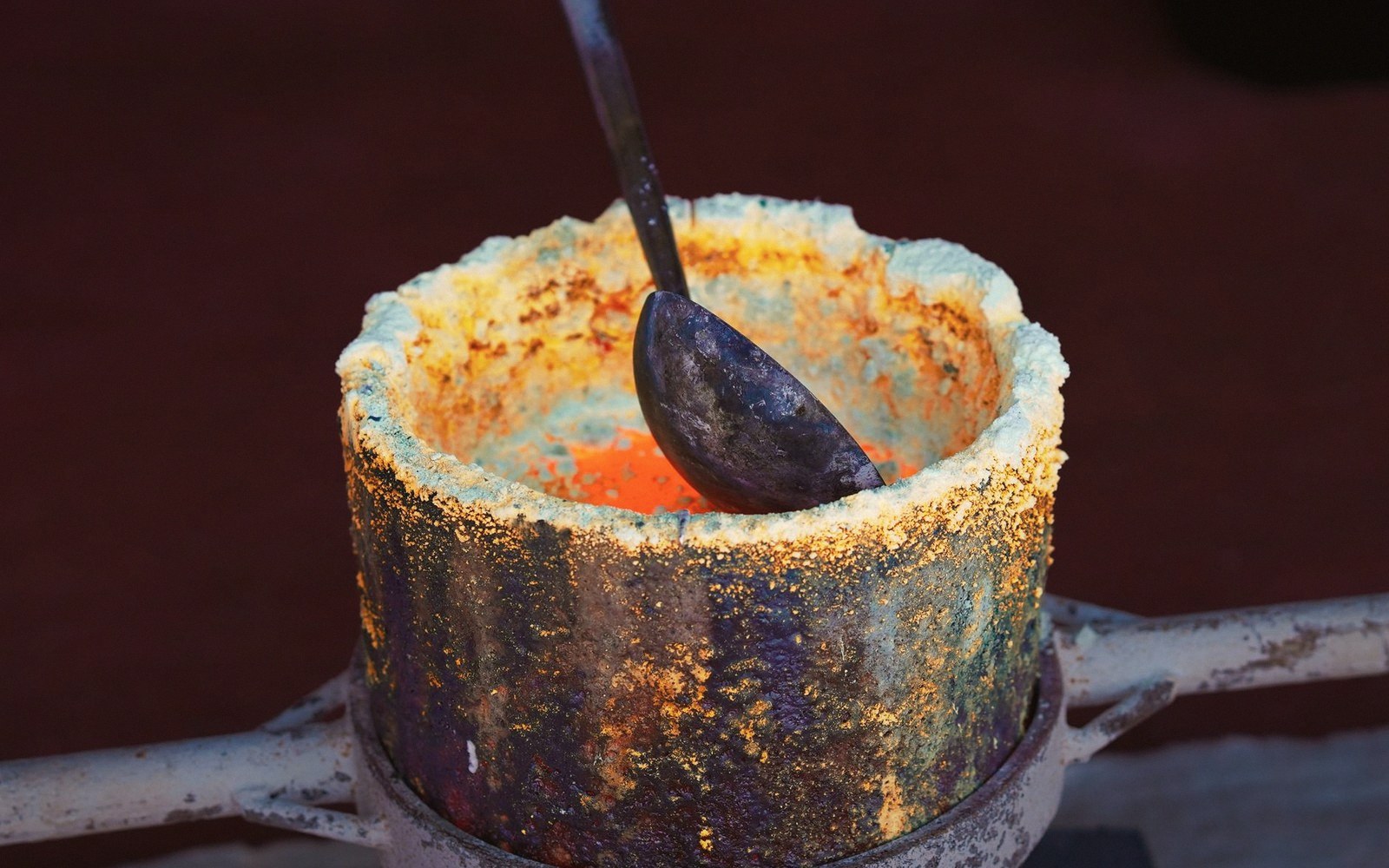
Charcoal, forced air and a crucible sitting in the fuel rather than above it.
Photo: Panta Singha / PexelsThe scrap hoard as working capital
The scrap hoard is one of the defining assemblages of the Later Bronze Age, and it is consistently misread as evidence of loss or abandonment. It is neither. A hoard of fragmentary swords, broken socketed axes, flanged pieces, clipped rings and casting waste represents working capital — metal banked against the next commission. Smiths or metal traders accumulated broken objects because bronze is infinitely recyclable: the alloy survives re-melting with minimal degradation, and a broken sword yields exactly the same raw material as an ingot, gram for gram. The presence of mixed object types in a single deposit, often with pieces from visibly different casting traditions, is evidence of collection rather than manufacture — a stock deliberately assembled from multiple sources.
Chronology and context
- Uluburun shipwrecklate 14th century BC; eastern Mediterranean; most complete Bronze Age cargo assemblage known
- Ox-hide ingotscopper, up to ~30 kg each; named for four-cornered notched shape; distributed across Mediterranean and into central Europe
- Bun ingotsplano-convex rounded copper cakes; common in European contexts
- Later Bronze Age scrap hoardsconcentrated roughly 1100–800 BC in northwest Europe; the paradigmatic period for recycling-dominated metal economy
The critical analytical evidence is chemical. Lead isotope analysis and trace element studies can, with varying degrees of resolution, link finished objects to ore sources and sometimes to earlier objects. Work on Later Bronze Age hoards from Britain and France has shown that metal from broken objects re-entered circulation and was re-cast into objects with compositional signatures that no longer match any single ore source — the signature of repeated recycling blurring the geological signal. Proportion and hardness varied accordingly: a workshop melting mixed scrap could not know its tin content with precision, and the variable compositions found across objects from a single hoard or site reflect exactly this uncertainty.
Uprights standing in standing water. Below the water table timber survives; above it, it does not.
Photo: Estonian Stalker / PexelsCasting waste — sprues, jets, mis-runs — appears in many scrap hoards alongside the broken objects, confirming that these deposits were often associated with smithing activity rather than simply with trade. But the distinction between a travelling smith's toolkit and a trader's metal stock is difficult to draw from archaeology alone, and the ambiguity is probably deliberate: in a world without coinage, metal itself was the medium of exchange, and the line between raw material and portable wealth was permanently blurred.
What the chemistry shows
| Item | What the record says |
|---|---|
| Lead isotope analysis | links metal to geological ore source; useful but not always unambiguous |
| Trace element studies | minor metal content can fingerprint smelting region or ore batch |
| Repeated recycling | progressively blurs the original geological signal, producing mixed compositions with no single-source match |
What this means for reading any given hoard is that the question is not why it was buried but what it was doing before it went in the ground. The metal in a scrap hoard had already lived several lives — ore, ingot, object, fragment — and the deposition, whether ritual, precautionary or simply never retrieved, is only the last episode. The economic logic that assembled the hoard is older than the hoard itself, and it runs on the same principle as every later metals market: the stuff holds value because it can always become something else.