Copper Sources
Where it was mined, how the ore was roasted and smelted, and what the spoil says.
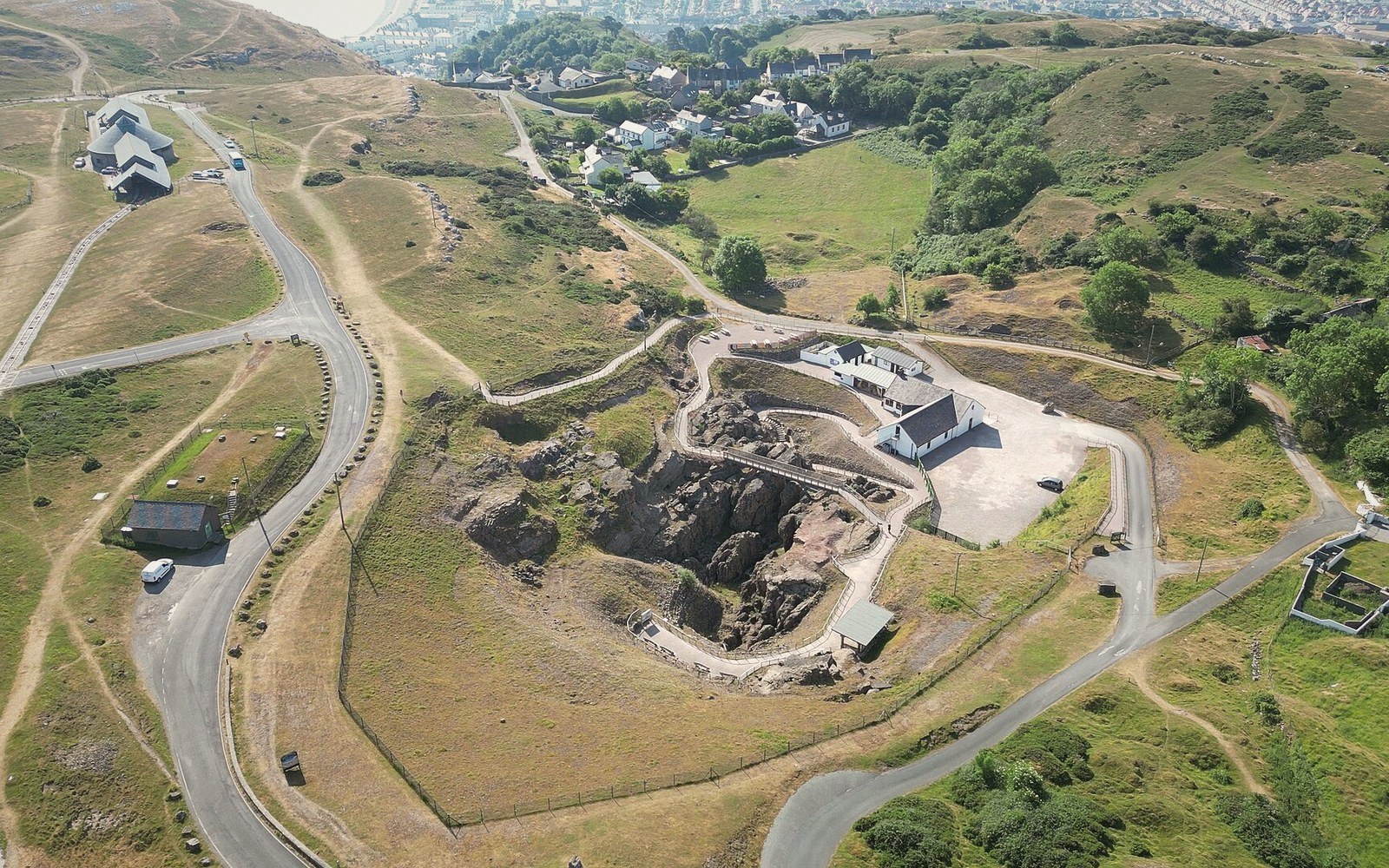
Great Orme, north Wales. Workable copper occurs across much of Europe; the spoil is often all that is left of the working.
Photo: Mwyngloddiau Copr y Gogarth - Great Orme Copper Mines; Mehefin - June 2023 01 · Wikimedia CommonsThe rock beneath the trade
Bronze Age Europe ran on copper, and copper came from specific places — places that can, in most cases, be identified. The ore does not lie evenly across the continent. It concentrates in the Eastern Alps, in the Iberian Peninsula, in Cyprus (which gives the metal its Latin name), in Sardinia, in the British Isles, and in parts of the Carpathians and the Balkans. Each deposit carries a trace-element fingerprint: small quantities of arsenic, bismuth, lead, nickel and cobalt that vary by geology and survive the smelting process into the finished object. Lead-isotope analysis and trace-element profiling — neither technique without its critics — allow archaeometallurgists to compare a spearhead found in the Thames with ore bodies still visible in the ground.
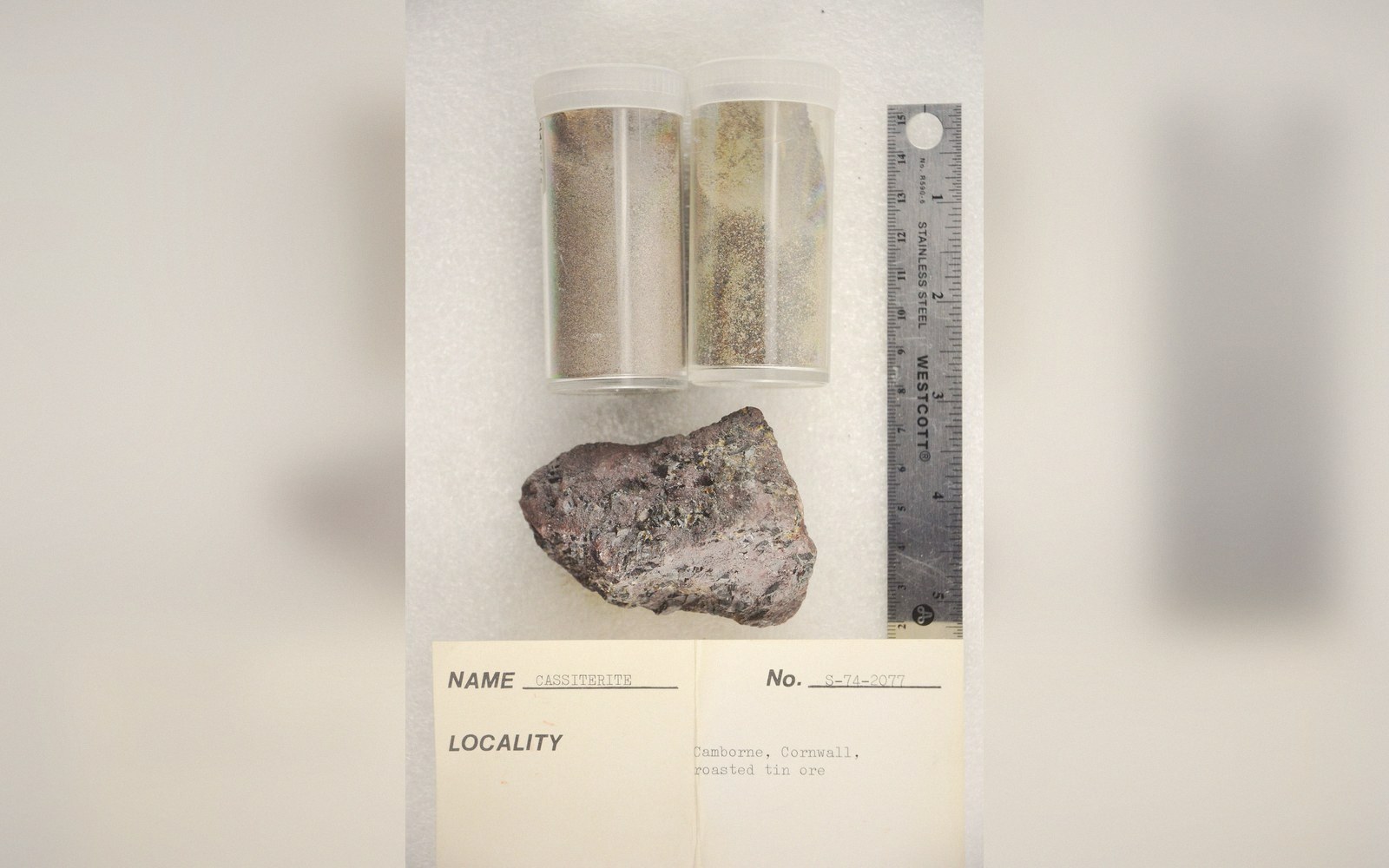 Plate iii
Cassiterite, the principal tin mineral, beside roasted ore. Concentrated in a handful of regions, and the constraint the whole period runs on.
Photo: Cassiterite with Roasted Tin Ore · Wikimedia CommonsThe Alpine mines are among the best-documented. At Mitterberg in the Salzburg region, and in the Inn and Mur valleys more broadly, systematic extraction had begun by the early second millennium BC. The sites are not shallow scratchings: miners drove horizontal adits into copper-bearing quartz veins, supported their workings with timber, and sustained operations over centuries. Fire-setting — lighting a blaze against the rock face to crack it by thermal shock, then quenching it — was the primary extraction technique, and the evidence is unmistakable: thick deposits of charcoal, heat-reddened rock, and the irregular, scorched roof profiles that no other process produces. The scale of the Mitterberg complex alone suggests production that far exceeded any local demand, which is itself evidence of organised, long-distance distribution.
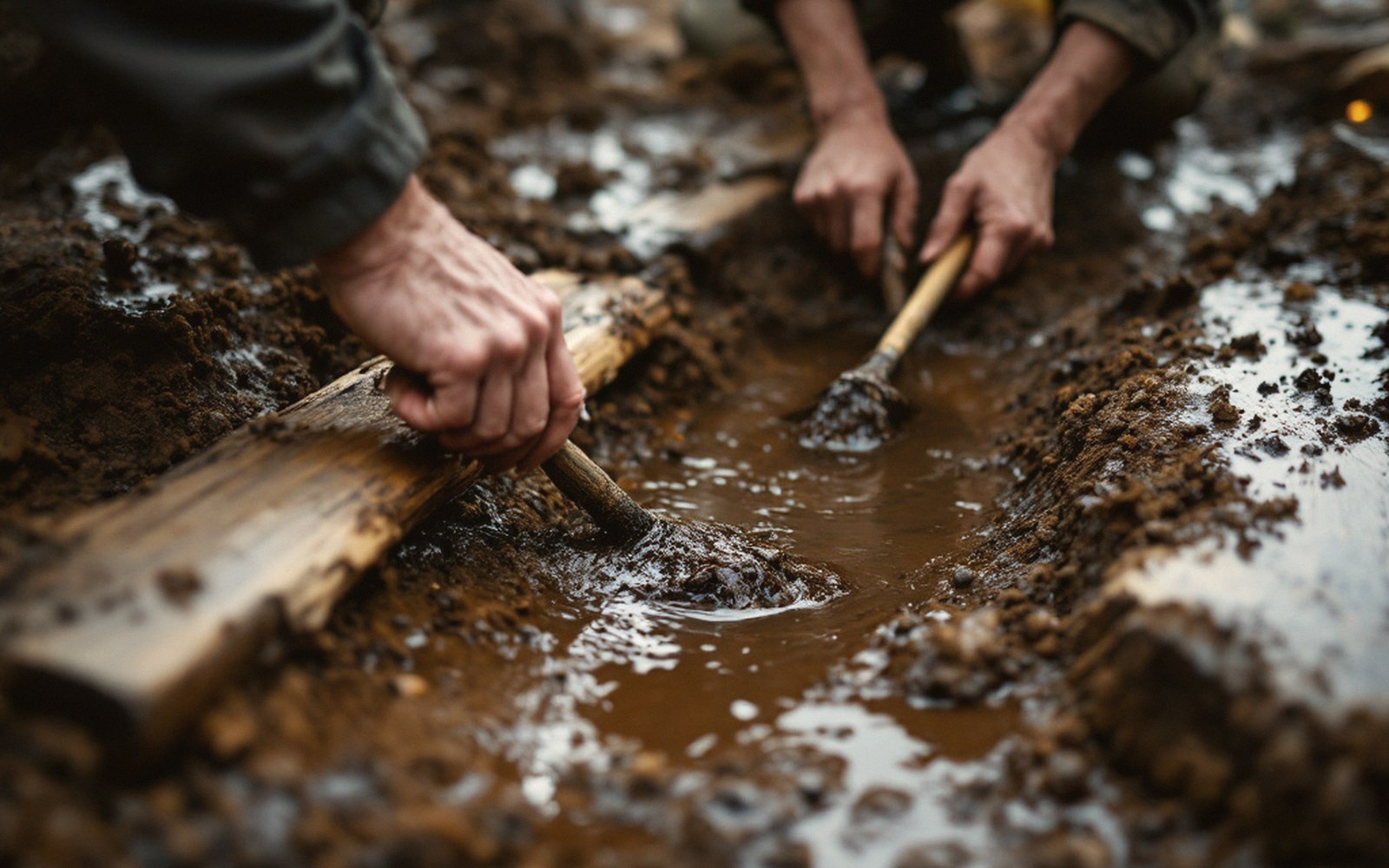
A trench in wet ground is pumped for as long as it stays open. The water that preserved everything also makes it hard to see.
Roasting, smelting, and what the slag reveals
Getting copper from ore is a two-stage process. Most Bronze Age copper ores are sulphides — principally chalcopyrite — and these must be roasted before smelting: heated in an open fire with some air circulation to drive off sulphur and convert the ore to a more tractable oxide. The roasting leaves evidence that is hard to miss: patches of calcined ore, slag droplets, and often the remains of shallow pits or stone-lined hearths used as roasting beds. At many Alpine and Iberian sites, these features cluster near the ore bodies themselves, reducing the weight of material that had to be transported before further processing.
Key sites and their signatures
| Item | What the record says |
|---|---|
| Mitterberg, Salzburg | one of the largest known Alpine Bronze Age mining complexes; horizontal adit mining and fire-setting |
| Great Orme, north Wales | extensive Bronze Age copper mine; surface and underground workings well documented |
| Rio Tinto, Huelva, Spain | major Iberian copper source with evidence of Bronze Age exploitation |
| Cyprus | eponymous source (kypros → cuprum); exported copper widely across the eastern Mediterranean |
Smelting came next, in a crucible and furnace arrangement where forced air — from bellows, almost certainly — drove charcoal combustion hot enough to reduce the oxide ore to metal. The copper that ran out at the base was impure, typically containing residual iron and other elements. Tap slag — the glassy, iron-rich waste that flows from a smelting furnace — is denser than wood ash or roasting debris, and it survives well on the surface of excavated sites. Its chemistry is a direct record of the ore being processed. Where the slag has been properly sampled and analysed, it is possible to reconstruct not only the ore source but something of the operational temperature and furnace design.
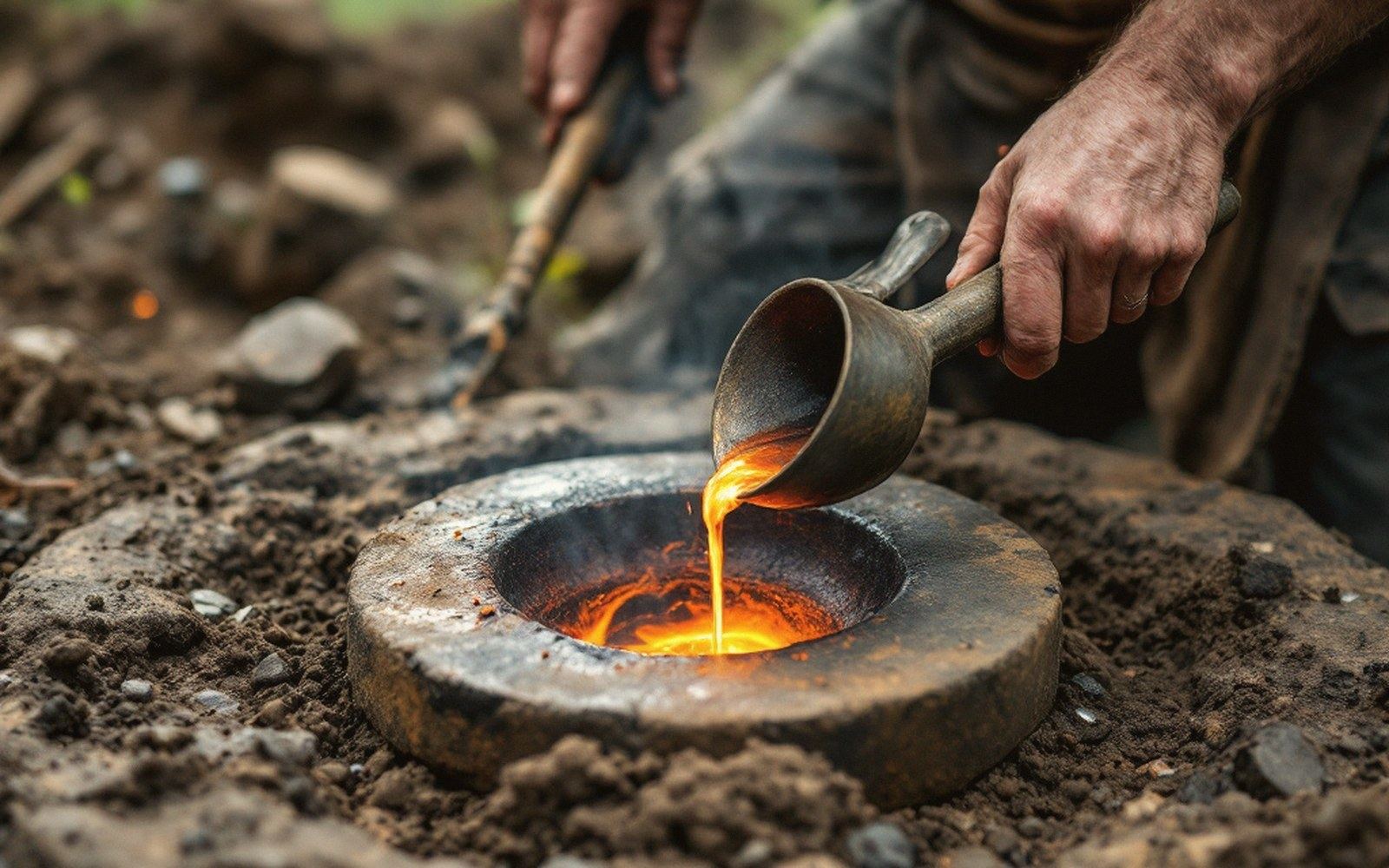
The pour cannot be paused, corrected or repeated. Everything before it is preparation for about twenty seconds of work.
The resulting copper was cast into rough bun ingots or plano-convex cakes — flat on one face, domed on the other — for transport. These are found at mining sites, at riverine and coastal transit points, and occasionally as ingots and scrap in hoards. The bun shape is not arbitrary: it minimises surface area relative to volume, reducing oxidation during remelting, and the form is consistent enough across different regions to suggest shared practical knowledge.
Extraction evidence types
| Item | What the record says |
|---|---|
| Fire-setting | cracking rock by heating then quenching; leaves scorched roof profiles and heavy charcoal deposits |
| Tap slag | glassy iron-rich furnace waste; chemistry directly records ore source and smelting conditions |
| Roasting beds | shallow pits or stone hearths used to convert sulphide ores to oxides before smelting |
| Bun ingots / plano-convex cakes | transport form of raw copper; minimises oxidation surface during remelting |
What the mining spoil says collectively is this: the Bronze Age copper supply was not improvised. The Mitterberg workings, the Rio Tinto mines in southern Spain, the Great Orme on the north Welsh coast — these are specialised extraction sites requiring sustained labour, technical knowledge, and logistical infrastructure to move ore or metal away from sometimes remote upland locations. The concentration of production in a limited number of places, each with a distinctive geochemical signature, is precisely what gave copper its character as a traded commodity rather than a locally-obtained raw material. Communities near ore bodies were differently positioned from communities far away, and that asymmetry shaped the economics — and the power structures — of the whole period.