Tin and its scarcity
Bronze needs it, the Bronze Age rarely had it — and the regions that did shaped the trade networks of a continent.
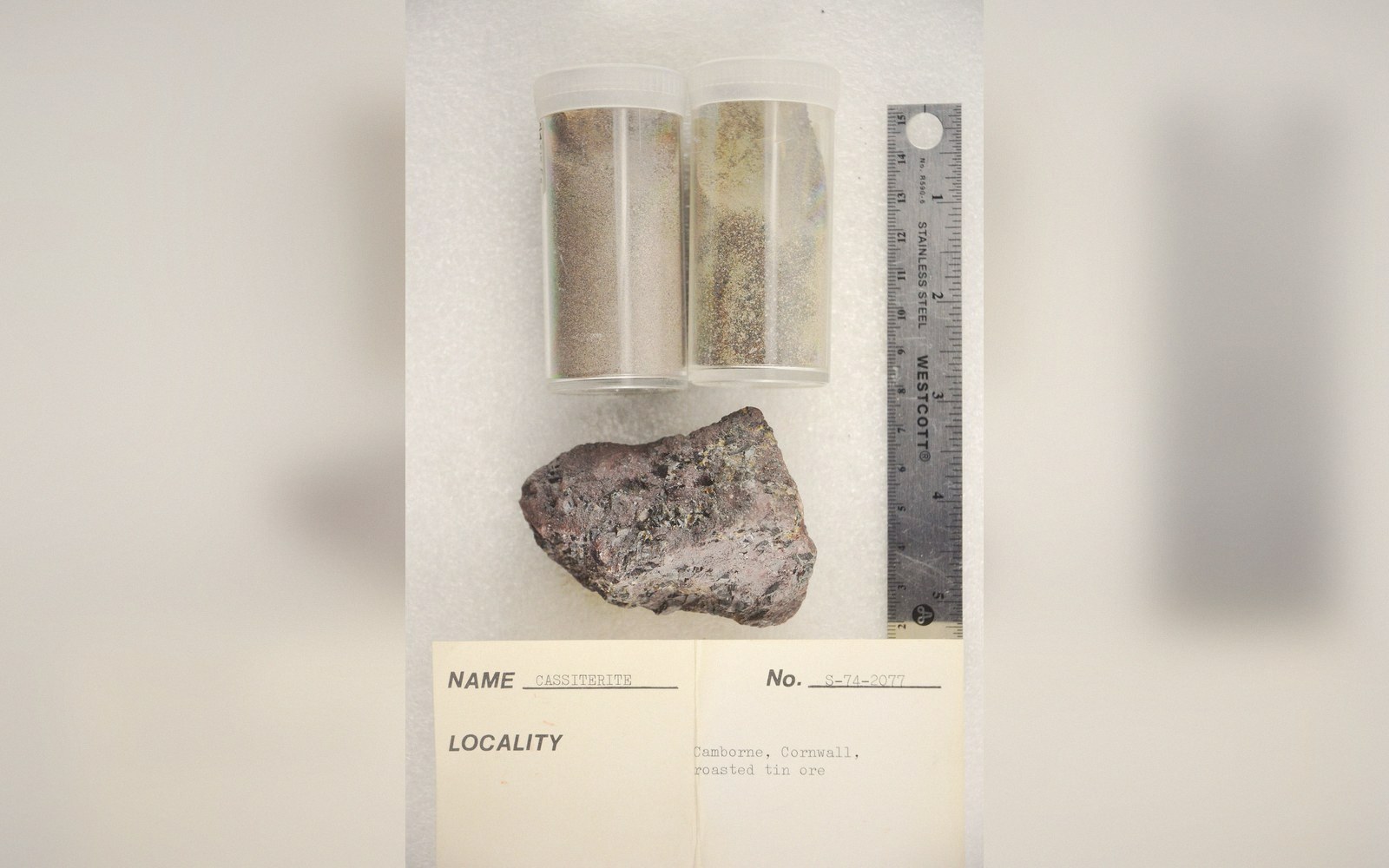
Cassiterite, the principal tin mineral, beside roasted ore. Concentrated in a handful of regions, and the constraint the whole period runs on.
Photo: Cassiterite with Roasted Tin Ore · Wikimedia CommonsThe geology of scarcity
Tin does not occur the way copper does. Copper mineralisation is widespread enough that most regions of Europe could reach a deposit within a few hundred kilometres; the map of copper sources is diverse, contested, and reasonably populated. Tin is different. The ore — cassiterite, tin dioxide — forms in granitic environments under very specific conditions, and its primary deposits cluster in a startlingly small number of places. For Bronze Age Europe, three regions matter most: the peninsula of Armorica in north-western France, the south-western tip of Britain (Cornwall and Devon), and the Erzgebirge, the ore mountains straddling what is now the Czech-German border. A scatter of secondary occurrences existed in Iberia and Sardinia, but none approached the scale of these three, and none could have supplied a continent's worth of bronze on its own.
The distances involved are worth sitting with.
The consequence is structural. Wherever copper came from — Ireland, the eastern Alps, the Iberian plateau, Cyprus — the tin to alloy with it almost certainly came from somewhere else, often far away. Bronze is not a local product even when the copper is local. The alloy requires a relationship, and that relationship across the breadth of Europe had to be maintained, renewed and negotiated for centuries.
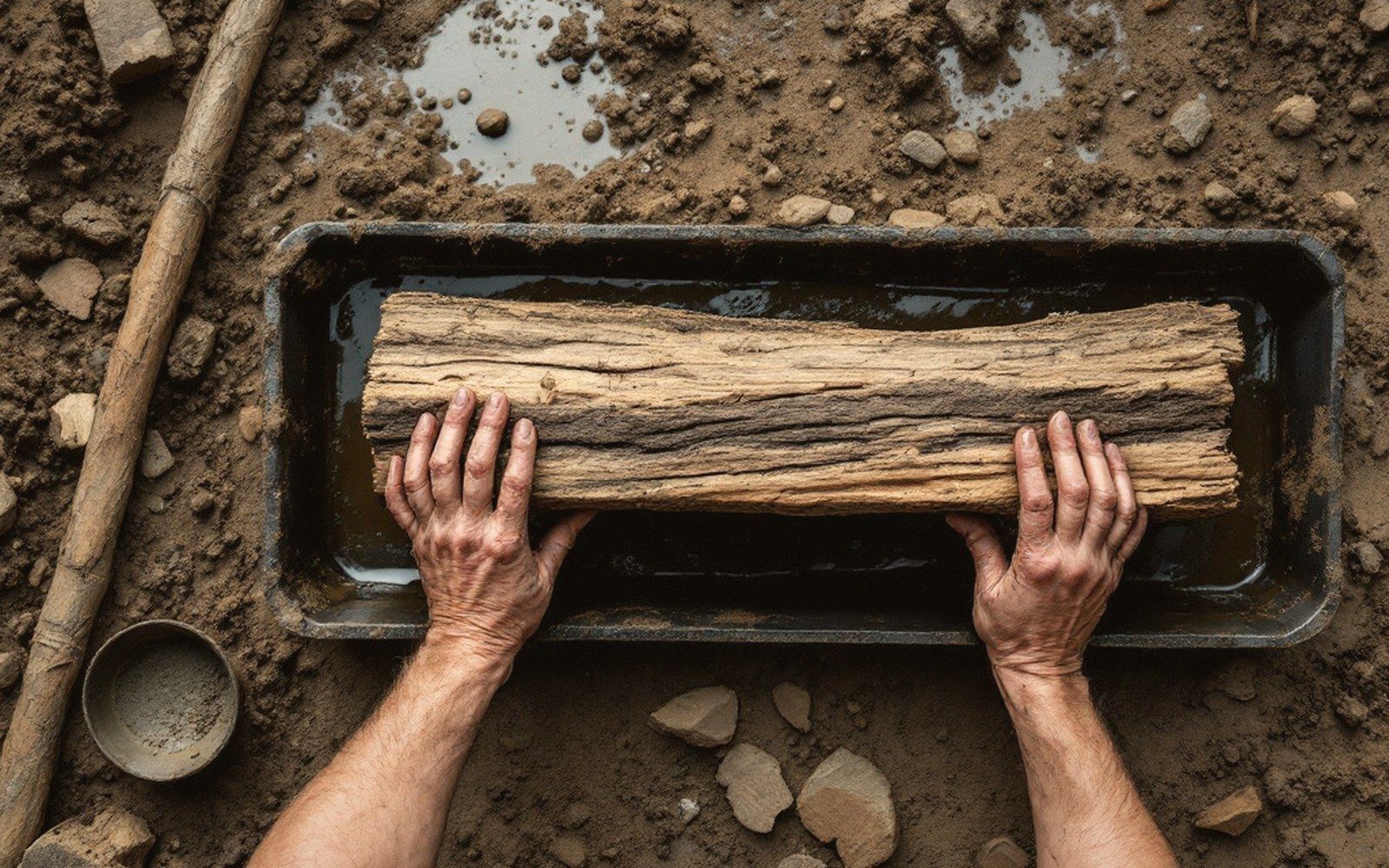
Waterlogged oak has the strength of soaked cardboard. It is lifted wet, carried wet and stored wet.
Moving metal across a continent
The distances involved are worth sitting with. Cornish tin reaching a Scandinavian smith, or Erzgebirge cassiterite cast into ingots and moving south to the Mediterranean, implies chains of exchange whose individual links we can rarely see directly. Tin does not survive in the soil the way copper objects do; metallic tin oxidises to a white powder and leaves no archaeological trace. What survives is bronze — the alloy already mixed — and it is from the ratios within that alloy, read through lead isotope and trace-element analysis, that researchers reconstruct tin's movement. The science is still contested: cassiterite from different deposits can share isotopic signatures, and the lead in bronze is not the lead in tin ore. But the directionality of the evidence points consistently toward the same few regions supplying a very large hinterland.
Key ore sources
| Item | What the record says |
|---|---|
| Cassiterite (tin dioxide) | the primary ore mineral; forms in granitic settings and is geologically rare |
| Cornwall and Devon | the dominant British source; river-placer as well as lode deposits |
| Armorica (north-western France) | significant continental source within range of Atlantic trade routes |
| Erzgebirge ("ore mountains") | the Czech-German border range; major source for central European bronze production |
The ingots and scrap that circulated were the mechanism. A founder working anywhere between Ireland and the Aegean might receive tin as part of a composite consignment — copper ingots alongside broken tools and tin in whatever form it travelled — and the proportions mixed at the furnace reflect both recipe and availability. Where tin was scarce, smiths stretched it; where supply was reliable, the ratio varies more consistently toward the approximately ten-percent standard that gives the best combination of castability and hardness.
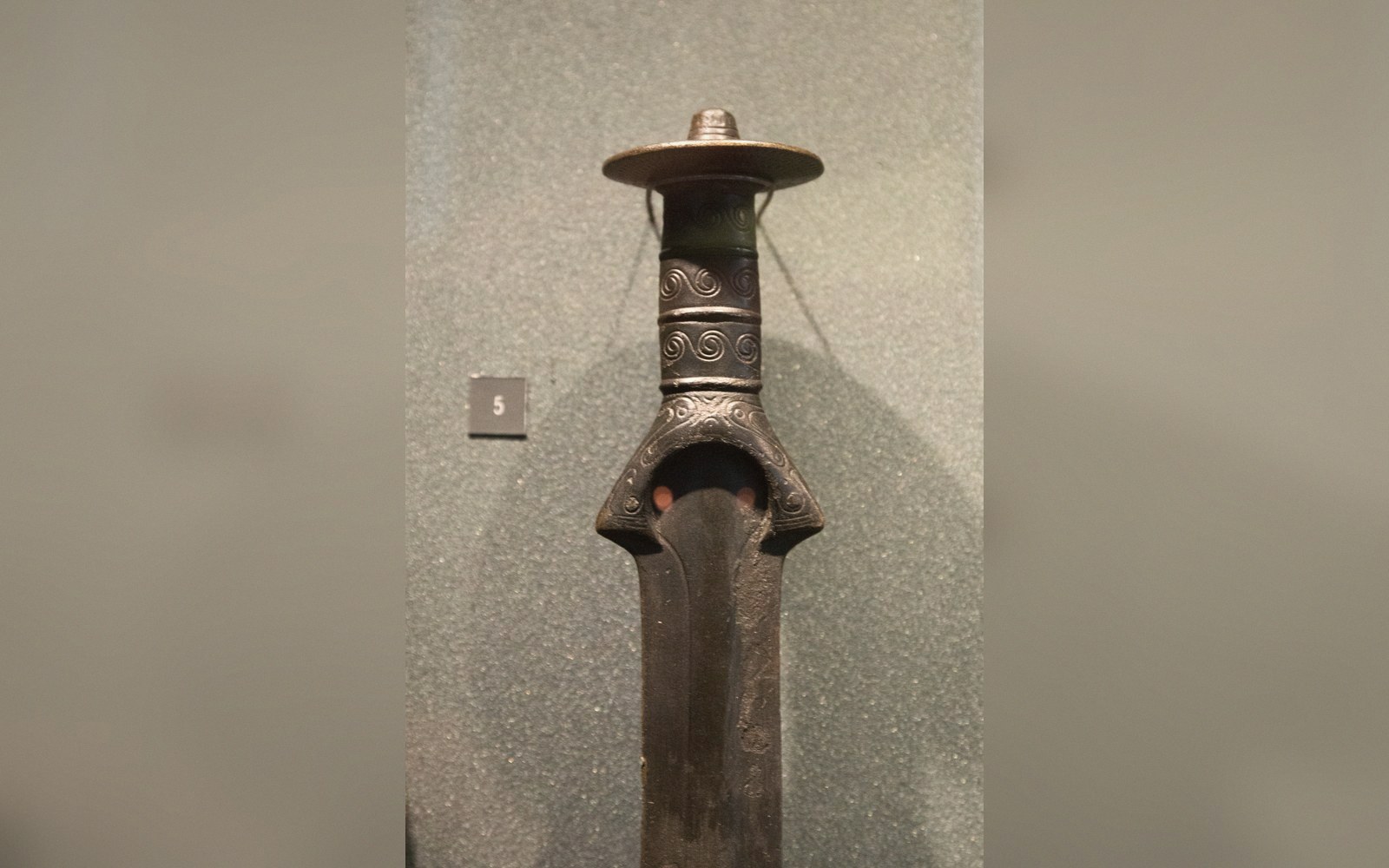
A blade on the bench before cleaning, corrosion intact. Most of what is known about typology was read off objects in this state.
Photo: Sword, Late Bronze Age, City of Prague Museum, 175563 · Wikimedia CommonsControl and consequence
Scarcity concentrates power. Any community that sat astride a tin-producing region, or controlled the portage point on a route between a tin source and its customers, occupied a position of structural advantage that translated fairly directly into wealth and, very likely, political authority. The burial record near Cornish tin-producing areas includes high-status graves with objects that signal wide connections. The same pattern appears in the Erzgebirge foothills during the Middle Bronze Age: metalwork of unusual quality, evidence of long-distance contact, and a density of deposition that suggests communities with more bronze moving through their hands than an ordinary local economy would account for.
Why isotopes help (and why they don't fully solve it)
| Item | What the record says |
|---|---|
| Lead isotope analysis reads the lead in a bronze object and compares it to known ore sources | |
| Tin isotopes are a newer and still-developing tool; results remain contested | |
| Cassiterite from different sources can share signatures | the method points toward regions, rarely to a single mine |
That advantage was also a vulnerability. A community dependent on distant tin — which meant nearly everyone — could be cut off by disruption to a trade route, a shift in the alliances that kept a portage open, or the exhaustion of a deposit. The Late Bronze Age reorganisations visible in the deposition record across Europe — the hoards, the river metalwork, the sudden changes in typological traditions — may partly reflect exactly these moments of disruption and reconnection. Bronze circulated as scrap precisely because the metal in it was too valuable to discard, and the tin already alloyed into a broken sword was tin that did not need to come from Cornwall or the Erzgebirge again.
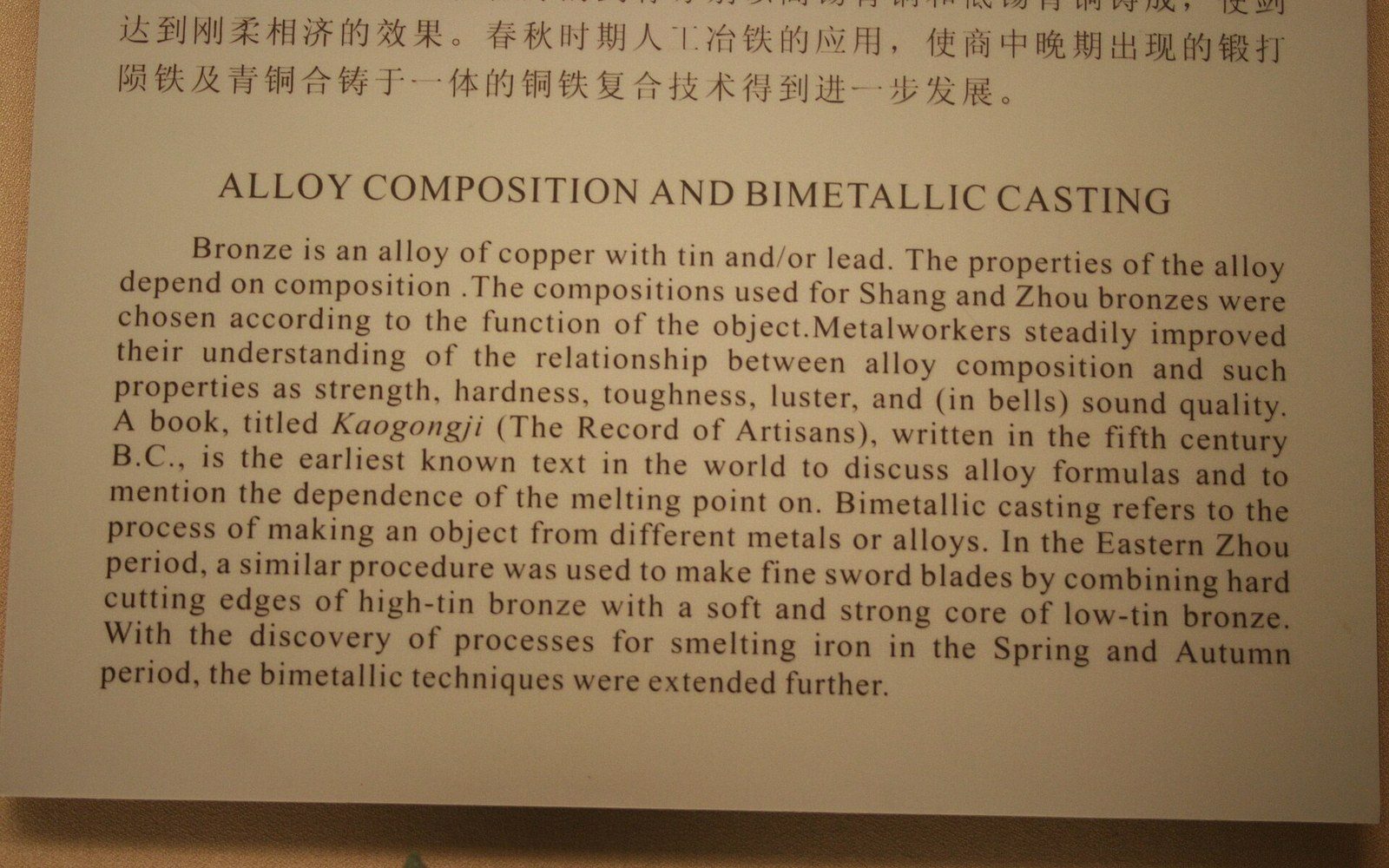 Plate iii
Museum text on alloy composition: the same trade-off between hardness and brittleness, recorded on the other side of the continent.
Photo: Alloy Composition and Bimetallic Casting · Wikimedia CommonsTin's rarity is the hidden driver behind much of what the Bronze Age looks like archaeologically. The causeways, the rivers, the hoards, the specialist founders — all of it is downstream of a geology that put a critical ingredient in very few places and then asked a continent to work out what to do about it.