Moulds
Stone, clay and lost wax, each leaving a different signature on the object.
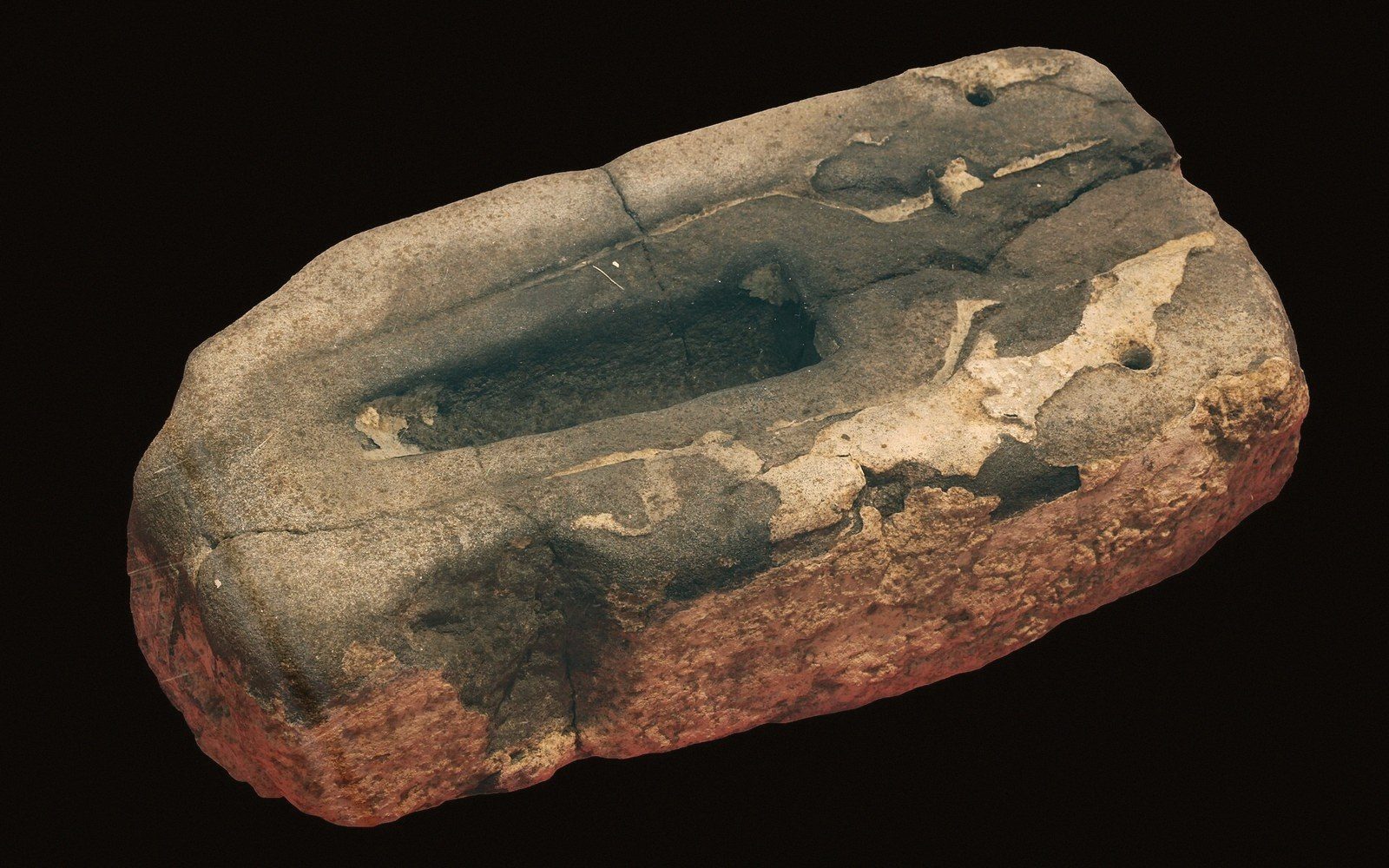
A stone mould for a spear tip, cut as the negative of the finished object.
Photo: Wikimedia CommonsWhat the mould leaves behind
Every Bronze Age casting carries a memory of the mould that shaped it. Stone, clay and lost wax each impose a different surface, a different geometry, a different limit — and a careful look at the finished object, or at the mould itself when one survives, can read those constraints back out of the metal.
Key signatures
| Item | What the record says |
|---|---|
| Flat longitudinal seam | stone or clay two-piece mould |
| Granular surface texture | fired-clay contact face |
| Absent seam, complex undercutting | lost-wax process |
| Flashing (metal fins) | gap between mould sections, most common with clay |
Stone moulds are the most durable and the most often recovered. The material of choice across much of north-western Europe was fine-grained sandstone or steatite (soapstone), both soft enough to carve with a metal tool yet stable enough to survive repeated pourings. A craftworker cut the negative form into one face of a dressed slab, incised a sprue channel — the groove down which the metal entered — and usually cut a pair of registration notches so that a matching slab or a flat backing stone could be aligned and held against it. The mould was then lashed or clamped shut, stood upright, and filled from the top. This is the open-and-shut mould, and its signature on the casting is a flat seam running the length of the object where the two faces met, plus occasionally a slightly rougher texture on the back face where metal met plain stone rather than a carved cavity. Stone moulds were reusable, probably for the lifetime of the workshop, and the same mould sometimes shows signs of recutting — a worn profile re-sharpened, a dimension corrected — suggesting a long working life shared across multiple generations of the same smithing tradition.
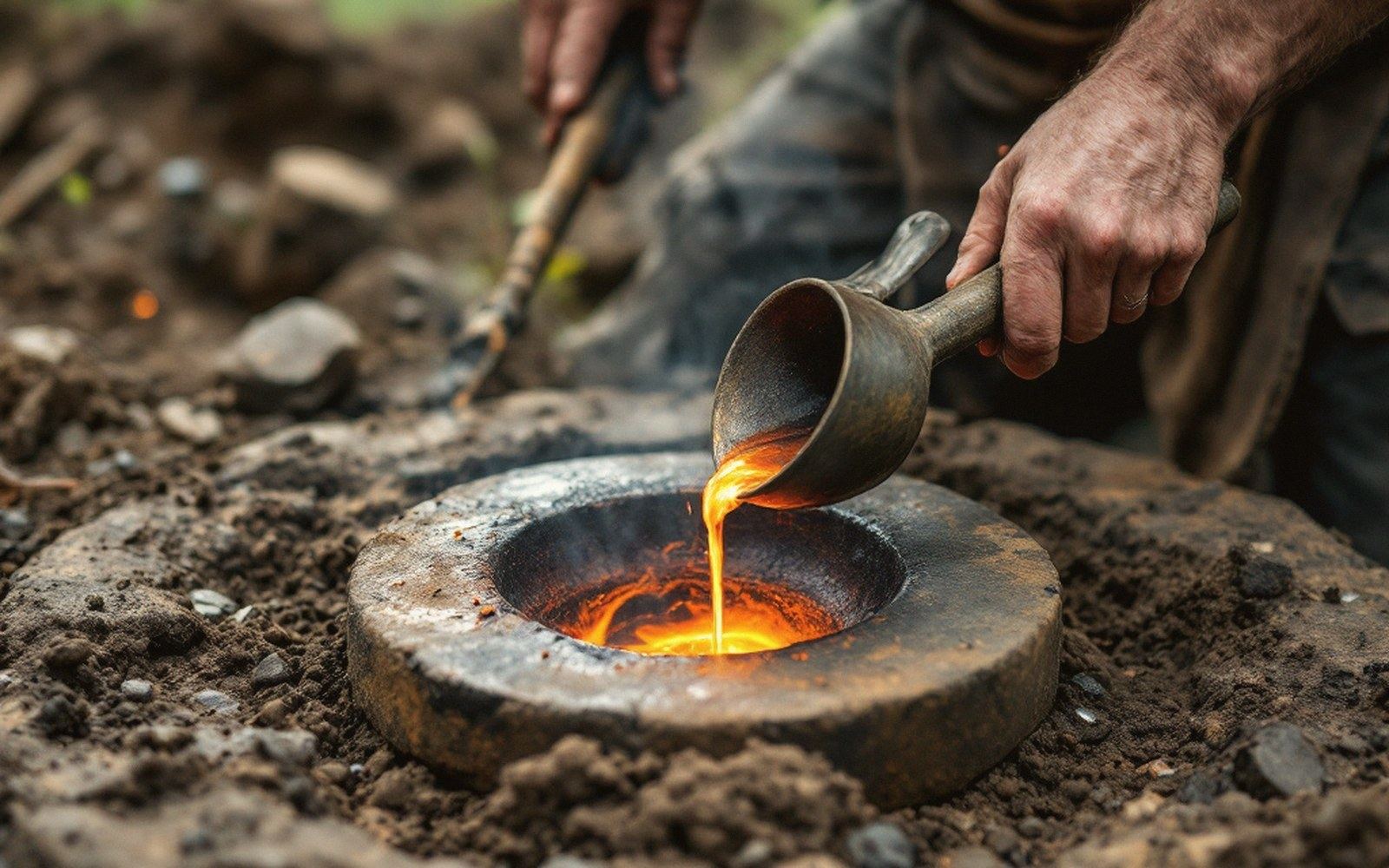
The pour cannot be paused, corrected or repeated. Everything before it is preparation for about twenty seconds of work.
Clay moulds leave a quite different record. They were used where complex flanged or socketed forms made a rigid two-piece stone version impractical, and the clay could be packed around a core or shaped inside a matrix and then fired before pouring. Clay is friable once the metal is solid, so the mould was broken away; it was single-use, and fragment assemblages rather than intact examples are the typical find. The fired-clay surface leaves a finer, slightly granular texture on the casting than stone does, and flashing — thin fins of metal that entered hairline cracks between the mould's sections — is often more pronounced. Where clay cores were used inside a socketed axe or spearhead, the casting could produce a form impossible to achieve in a two-piece stone mould alone. Excavated clay mould fragments from sites across central Europe have been pieced together to reconstruct the object being cast, sometimes — where enough pieces survive — confirming the exact sword or axe type to which that workshop was working.
Materials and method
| Item | What the record says |
|---|---|
| Stone (sandstone, steatite) | reusable; leaves a flat seam and a registration mark on the casting |
| Clay mould | single-use; broken away after pouring; survives as fragment assemblages |
| Lost wax (cire perdue) | single-use per object; allows undercuts and fine surface detail; no seam |
Lost-wax casting (the French term cire perdue still circulates freely in the literature) leaves the most eloquent signature of all, precisely because the mould is destroyed in use and no model survives. The craftworker built the object in wax, in full three-dimensional detail, coated it in layers of fine clay slurry, and fired the whole assembly. The wax melted and ran out — hence the name — and the metal filled the exact void the wax had occupied. The result can carry the finest surface detail: the incised lines, spiral ornament and cast-in decoration seen on elaborate socketed objects and cast ornaments from the later Bronze Age represent this technique at full stretch. Undercuts impossible in a split-stone mould are trivial in lost wax, and the seam is absent — each object comes from its own unique mould, which is why identical lost-wax castings are extremely rare and any apparent pair repays close scrutiny. The work done after the metal is solid still applies — sprues are cut off, surfaces chased — but the form itself arrived with a fidelity that stone could not match.
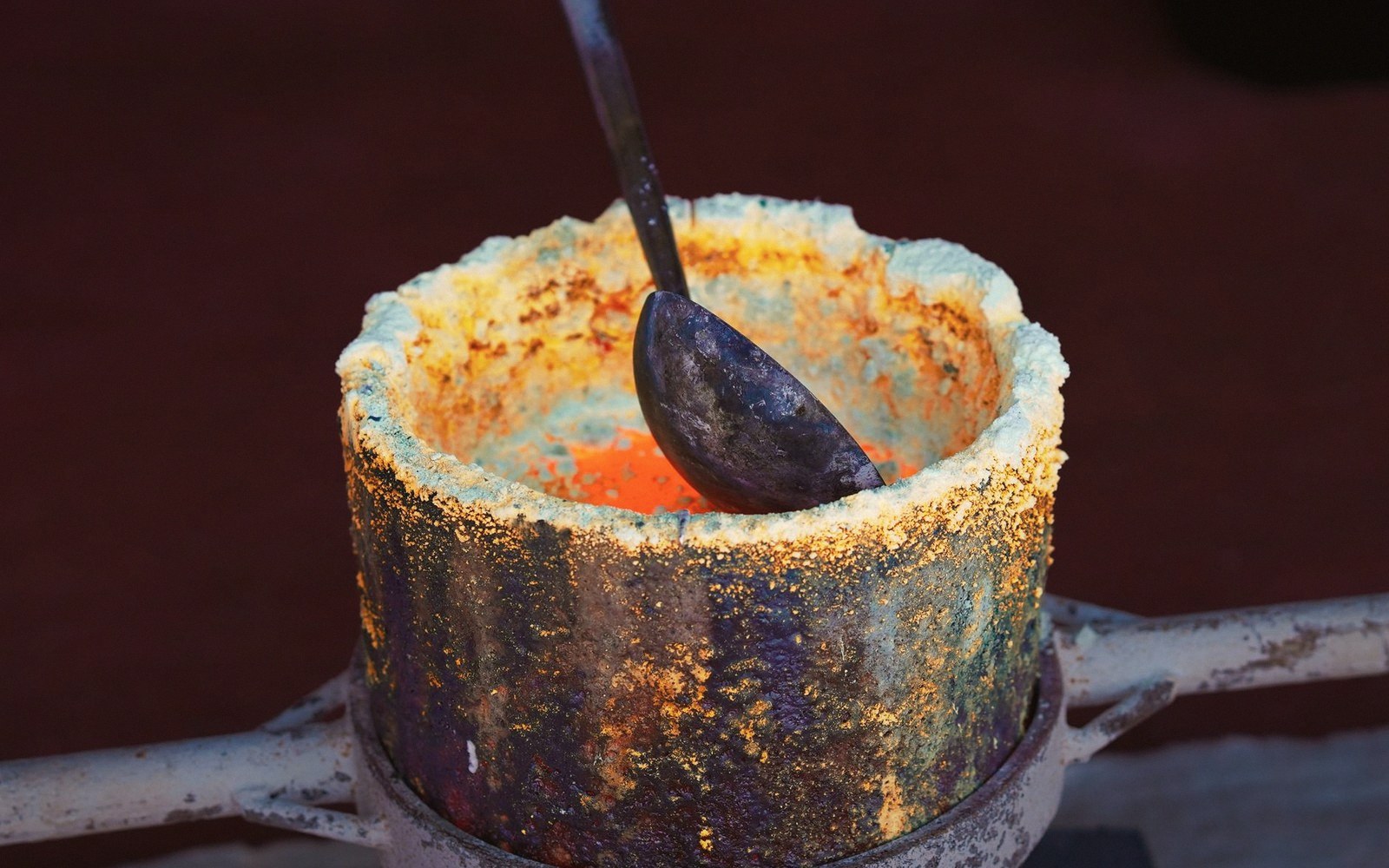
Charcoal, forced air and a crucible sitting in the fuel rather than above it.
Photo: Panta Singha / PexelsWhat ties all three methods together is that the mould, however it was made, was a carrier of technical knowledge. The choice of grain size in a clay slip, the angle of a sprue, the placement of vent holes — these decisions were accumulated and transmitted within workshops, and their repetition across geographically separated finds is itself evidence for the movement of people, not just finished metal.