Crucible and furnace
Getting to temperature with charcoal and forced air, and holding it long enough.
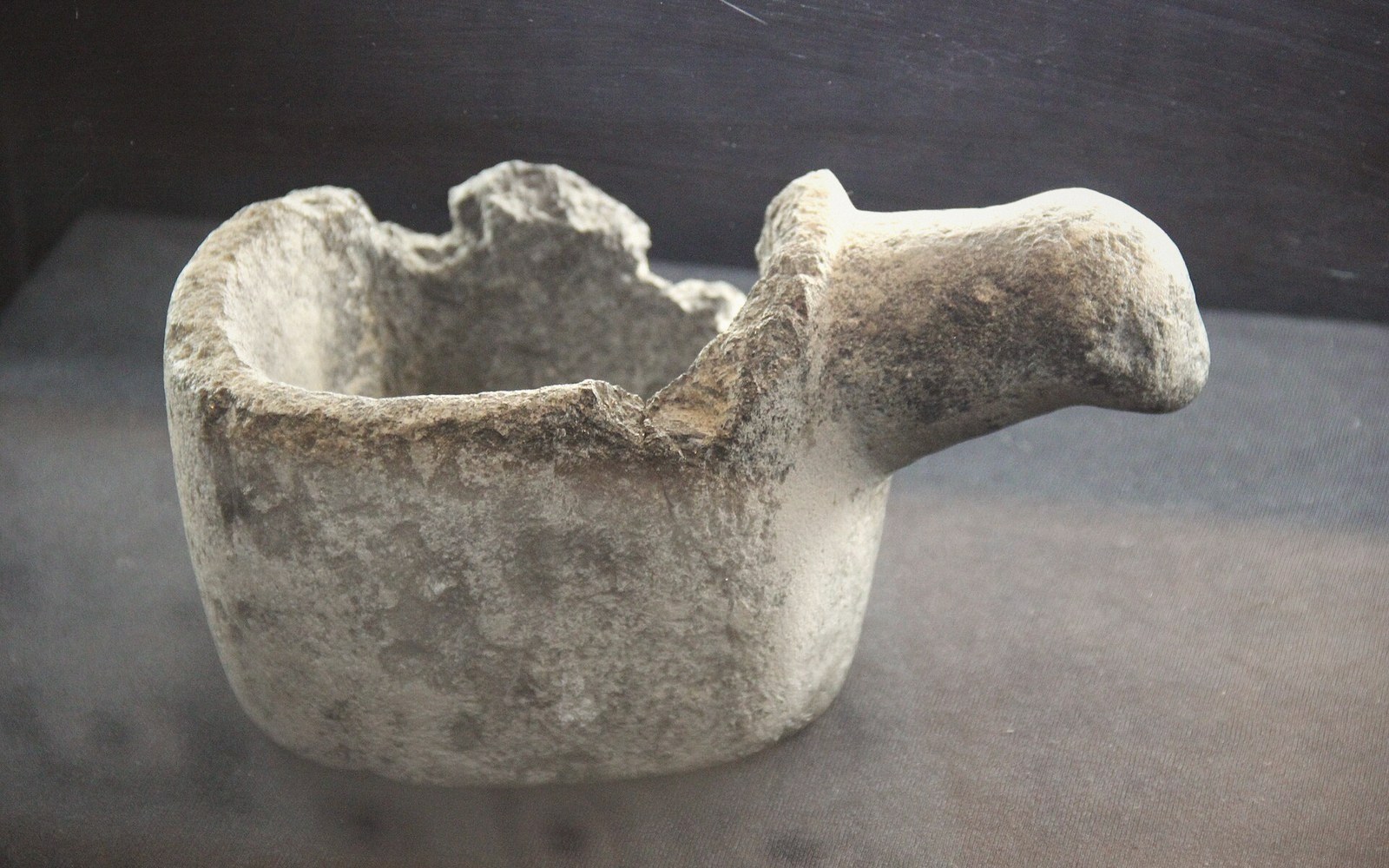
A crucible, vitrified on the inside by repeated heats. Fired ceramic survives where the charcoal and the bellows do not.
Photo: Bronze Early Iron Age Crucible, 800-300 BC · Wikimedia CommonsHeat enough to pour
Bronze melts at roughly 950–1000 °C, depending on the tin ratio. Charcoal and a bellows can reach that temperature; a simple open hearth cannot. Everything about Bronze Age casting turns on that gap — the difference between a fire you can cook over and one you can work metal with.
The furnace, in most Bronze Age contexts, is a shallow clay-lined pit or bowl, sometimes with low walls built up around it. Structural complexity varies by region and period, but the underlying principle is constant: contain the fuel and the charge close together, reduce heat loss from the sides, and drive oxygen in from below or at the base. The clay lining matters for insulation and for chemistry — unlined soil pulls heat away too fast and introduces unwanted minerals.
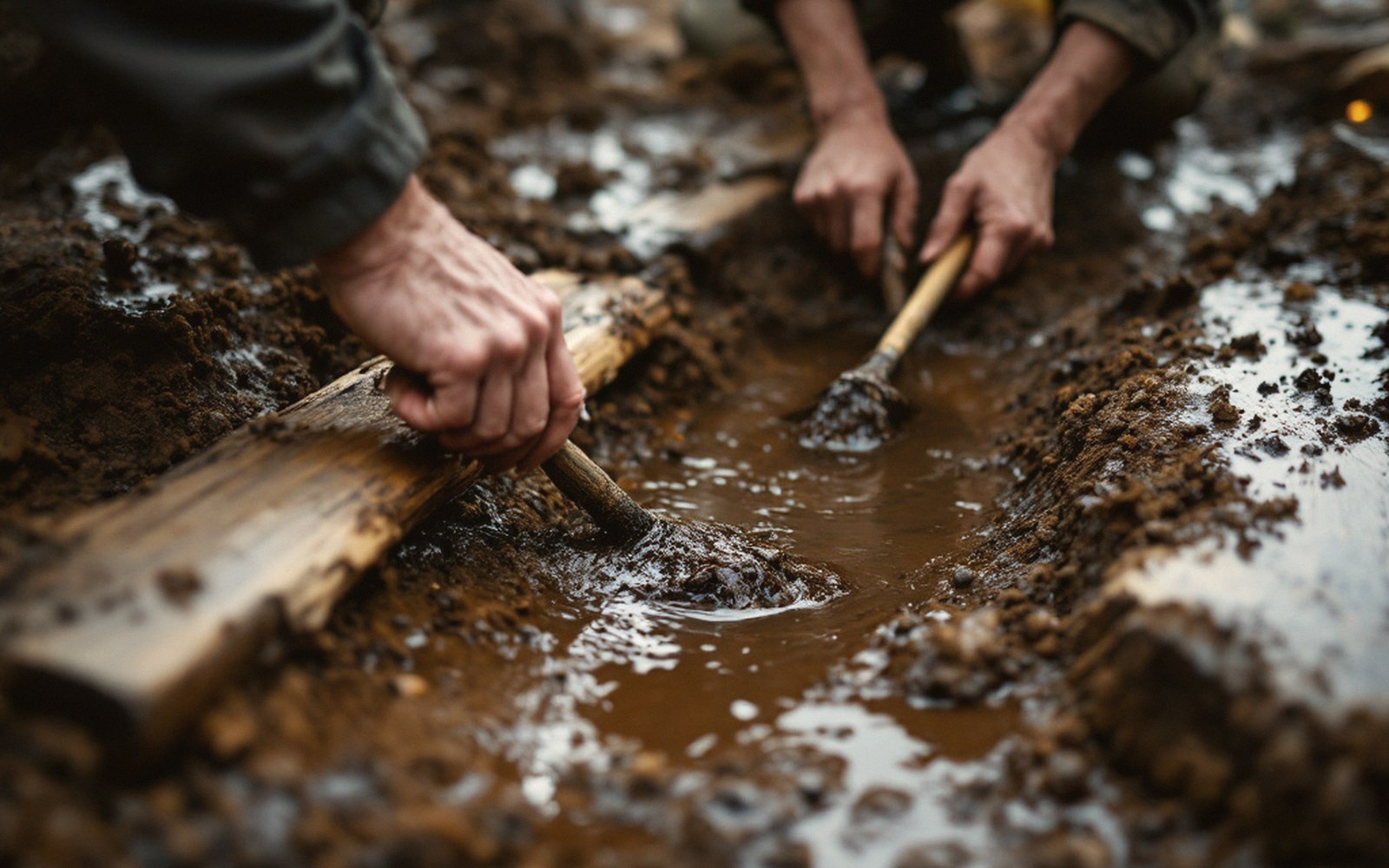
A trench in wet ground is pumped for as long as it stays open. The water that preserved everything also makes it hard to see.
Charcoal, not wood, is the fuel. Green or unseasoned wood burns too cool and too smoky. Charcoal, made in controlled reduction conditions, is almost pure carbon and burns hot and clean. Woodland management for charcoal production represents a significant and often underestimated part of the resource budget of any community smelting or casting metal, and there is good charcoal evidence at Bronze Age copper-production sites across the Alps and the British Isles, including the great mine complex at Mitterberg in the Austrian Salzburg region.
Key temperatures and materials
| Item | What the record says |
|---|---|
| ~950–1000 °C | approximate liquidus range for Bronze Age tin bronze, alloy-dependent |
| Charcoal | fuel of choice; almost pure carbon, burns hotter and cleaner than wood |
| Tuyère | clay air-inlet tube; the most archaeologically recoverable part of the bellows system |
| Cuprite | copper-oxide skin that forms on a molten melt surface and must be kept clear of the pour |
| Cold shut | a surface seam on a casting where two cooling metal fronts met before full fusion |
| Liquidus | the temperature above which an alloy flows freely as a liquid |
Bellows, tuyères, and the shape of air
Forced air is not optional. Without it, even good charcoal burns below the liquidus — the temperature at which the alloy flows freely. The standard Bronze Age solution is a skin or hide bellows, pumped by hand, feeding air through a clay tube. That clay tube — the tuyère — is the most archaeologically visible part of the system. Tuyères survive as heat-vitrified fragments in excavated metalworking deposits; their angles and diameters tell us how air entered the fire and at what approximate velocity. At Flag Fen itself, and at contemporary metalworking sites across temperate Europe, tuyère fragments appear in exactly the kind of contexts — alongside slag, crucible fragments and fuel ash — that mark a casting or smithing floor.
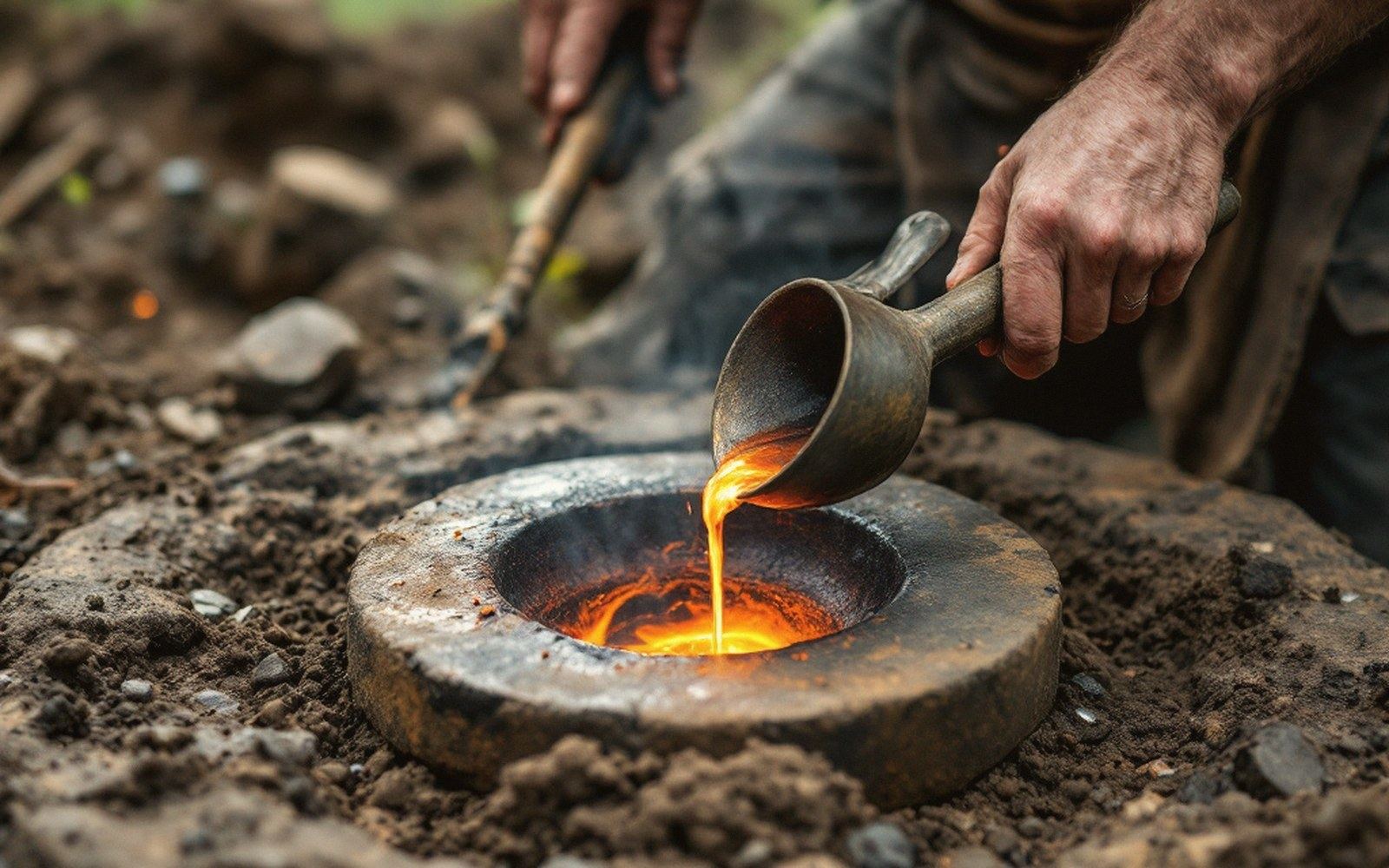
The pour cannot be paused, corrected or repeated. Everything before it is preparation for about twenty seconds of work.
The crucible sits in or immediately above the burning charge, surrounded by fuel, not resting on a grate over it. Proximity to the fuel is everything. Most Bronze Age crucibles are small, triangular or rounded vessels of coarse tempered clay, purpose-made for metalworking. They survive as cracked, slag-encrusted sherds, often with a telltale copper or tin stain on the interior that laboratory analysis can identify precisely. Some show pour spouts or deliberate shaping at the lip; many show repeated use evidenced by successive layers of vitrified slag. A single crucible typically held no more than a few hundred grams of metal — enough for a small axe or several smaller castings.
The evidence trail
| Item | What the record says |
|---|---|
| Tuyère fragments | heat-vitrified clay, angle and diameter informative about air delivery |
| Crucible sherds | coarse tempered clay, slag-encrusted, with analysable metal stains on interior surfaces |
| Charcoal deposits | found at smelting and casting floors; reflect woodland management as well as immediate process |
| Mitterberg, Austria | major Bronze Age copper production site with rich evidence of fuel and furnace practice |
Getting the charge to temperature is one problem; holding it long enough to pour cleanly is another. Bronze begins to oxidise at the surface once molten, forming a skin of cuprite that will ruin the casting if it folds back in. Working quickly and knowing when the melt is ready — colour, fluidity, the behaviour of the surface — are tacit, embodied skills that cannot be read off any artefact. Experimental work by archaeometallurgists, including the replicated Bronze Age casting experiments documented by groups working in the tradition of pioneering researchers such as Peter Northover, makes clear that the margin between a good pour and a failed one is narrow. Temperature, timing, and the control of oxidation all matter within ranges a skilled caster learns to read but cannot easily explain.
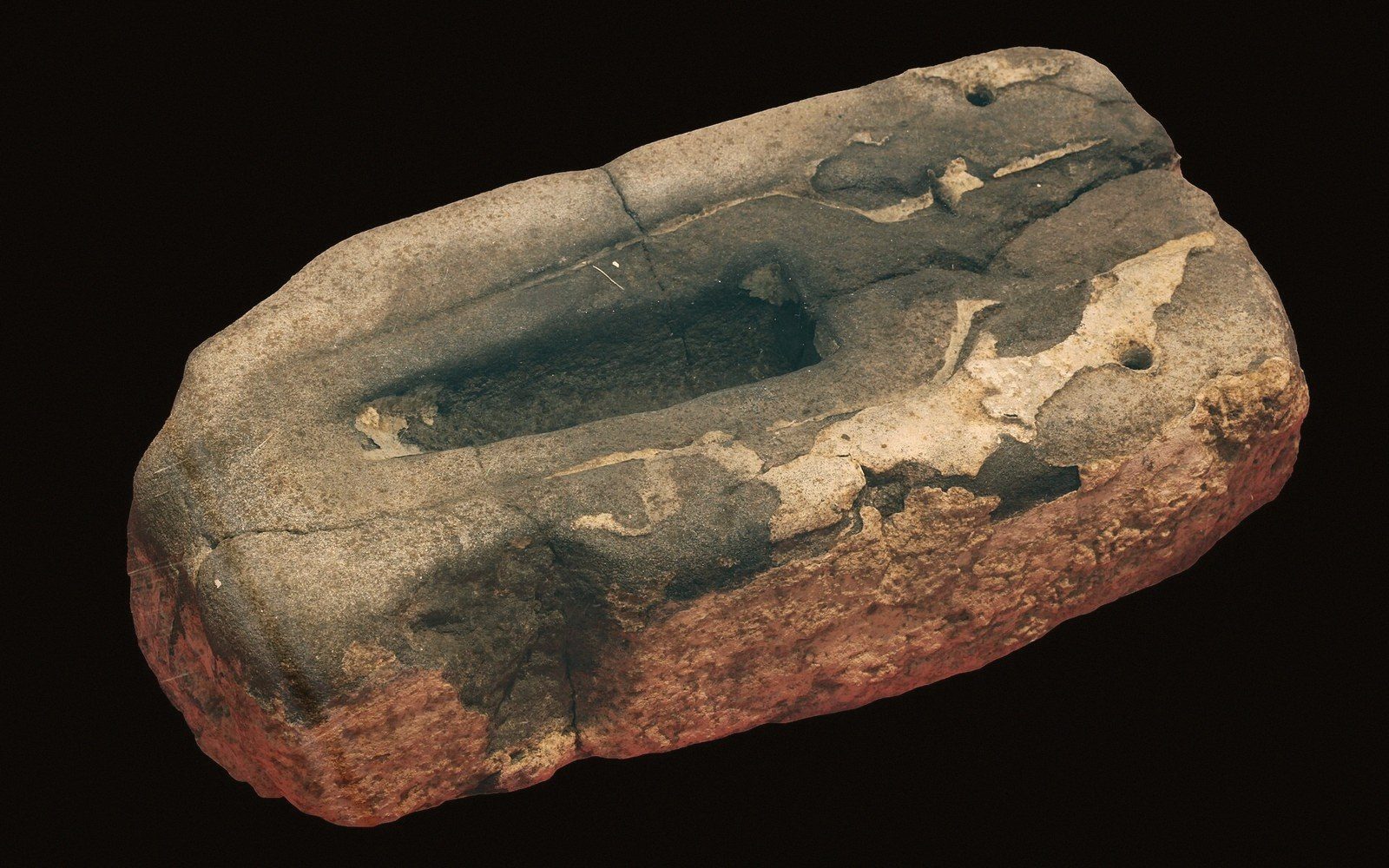 Plate iii
A stone mould for a spear tip, cut as the negative of the finished object.
Photo: Bronze Age spear tip mould IMG 5123 · Wikimedia CommonsFlux — usually charcoal dust or a small addition of another mineral — could be used to protect the melt surface and help impurities float clear, though the evidence for specific Bronze Age flux practice is inferential rather than direct. What is direct is the evidence of failure: miscast ingots, incomplete fills, and the cold shuts (surface seams formed when two fronts of cooling metal meet) visible on poorly executed finished objects.
Green or unseasoned wood burns too cool and too smoky.
The relationship between the alloy proportions in the final object and what the caster put in the crucible is never simple. Tin is volatile at high temperatures and some is always lost to the atmosphere; lead, sometimes added in small amounts, lowers the melting point and improves flow. The crucible was not just a vessel — it was a reactive environment, and the caster who controlled it was managing chemistry without knowing that word.