Jets, flash and finishing
Most of the work happens after the metal is solid.
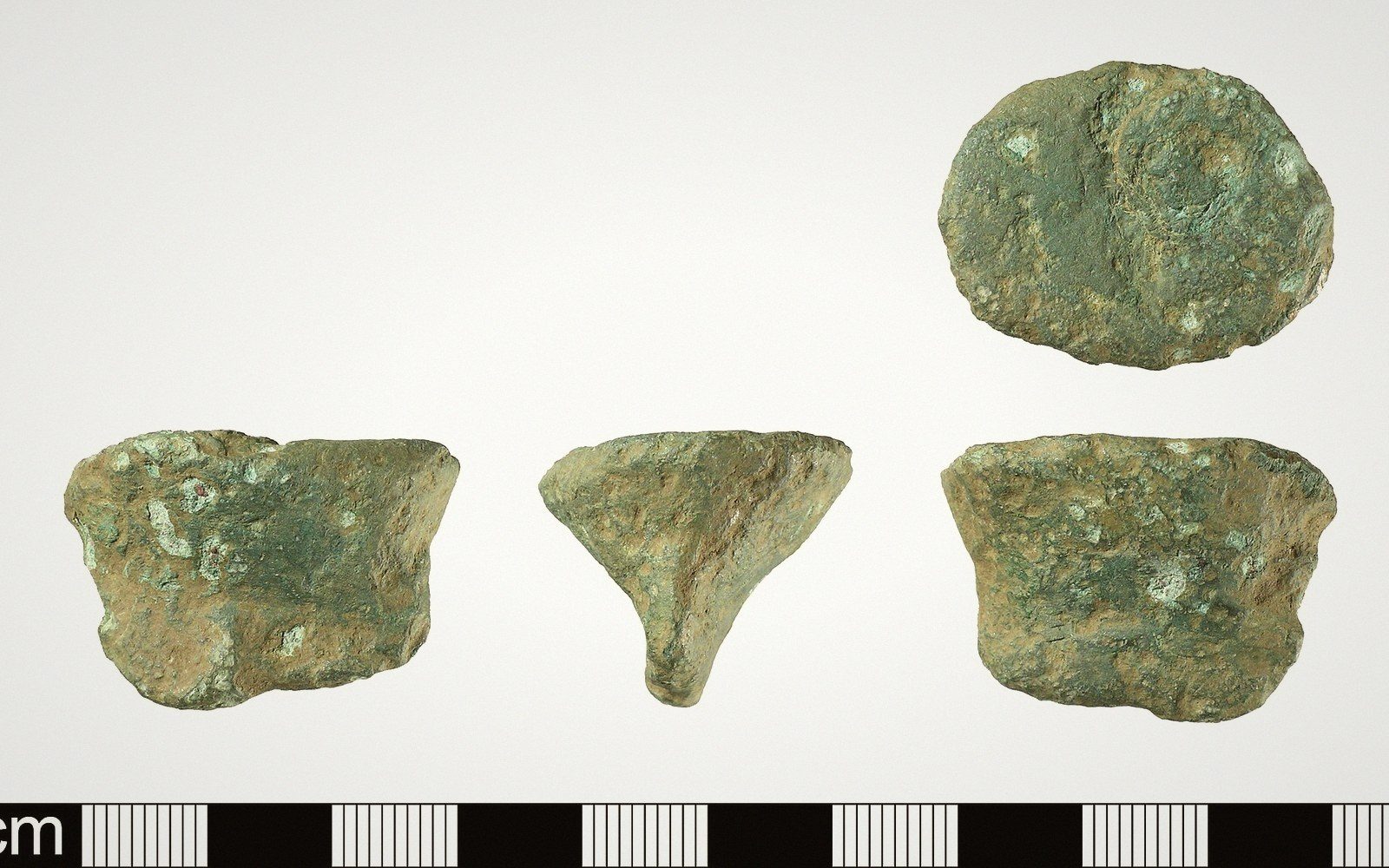
A casting jet: the plug of metal left in the funnel, cut off and remelted. On a workshop floor it is the clearest proof of casting.
Photo: Bronze Age casting jet (FindID 414065) · Wikimedia CommonsThe cast object is only the beginning
Pull a bronze sword or axe from its mould and what you hold is not a finished object. It is a rough casting: chilled metal carrying all the imperfections the pour introduced — jets, sprues, flash lines along the seam, bubbles frozen into the surface, a skin of oxides from the cooling. The real work is about to start.
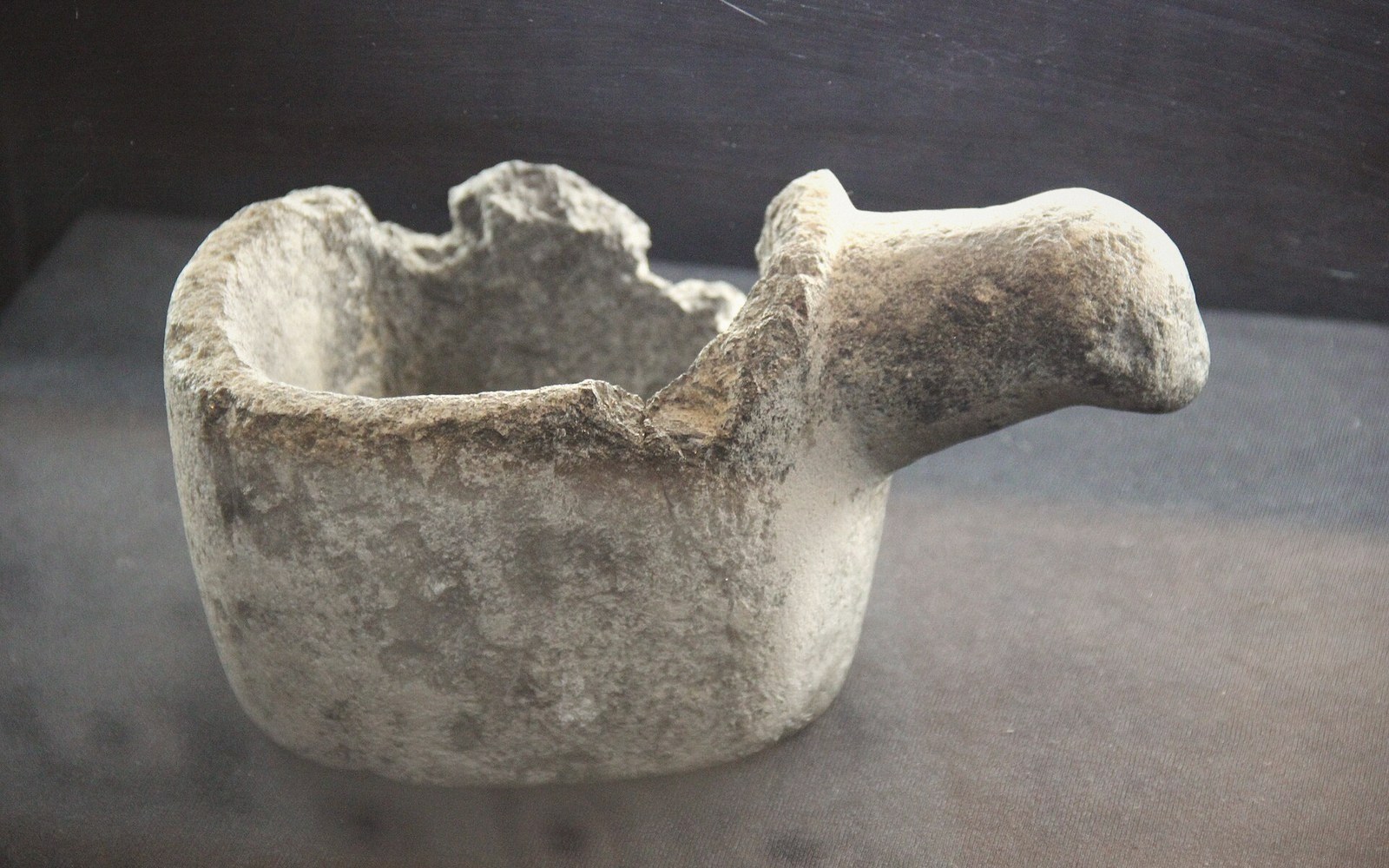 Plate iii
A crucible, vitrified on the inside by repeated heats. Fired ceramic survives where the charcoal and the bellows do not.
Photo: Bronze Early Iron Age Crucible, 800-300 BC · Wikimedia CommonsJets and sprues are the stubs of bronze that solidified in the channels feeding metal into the mould cavity. They must be cut or snapped off, and the stumps filed flush. Flash — the thin fin of metal that squeezed into the join between two mould halves — runs the full length of the seam. On a sword blade this can be a millimetre or more proud of the surface. Files and stone abrasives brought it down. The casting seam on finished Bronze Age swords is sometimes invisible; sometimes a faint ghost of it remains, readable under raking light or low-angle photography, which is how analysts track it now.
Waterlogged oak has the strength of soaked cardboard. It is lifted wet, carried wet and stored wet.
After the gross material was removed, the smith moved through progressively finer abrasives — sandstone, fine-grained schist, eventually leather charged with powdered stone. Experimental work has shown that a cast sword blade can be brought to a mirror finish in a few hours of sustained abrasive work, which in itself tells you something about the economics of the object: this labour was deliberately invested.
Sequence of operations
| Item | What the record says |
|---|---|
| Sprue removal | cutting or snapping the metal stubs left by the feed channels |
| Flash removal | filing the seam fins flush along mould join lines |
| Abrasive progression | coarse to fine stone, then leather, achieving a worked surface |
| Edge cold-working | hammering the cutting zone to harden the grain structure |
| Final polish | organic-assisted, no longer recoverable |
Hammering was part of the sequence too. The as-cast surface is slightly porous and relatively soft; cold-working the edge realigns the crystal structure of the bronze, hardening the cutting line without making the body brittle. Metallographic sections through Bronze Age blade edges regularly show this work-hardened zone — a clear signature in the grain — and it is almost always present on objects intended to cut. The smith knew what they were doing even without knowing the metallurgy.
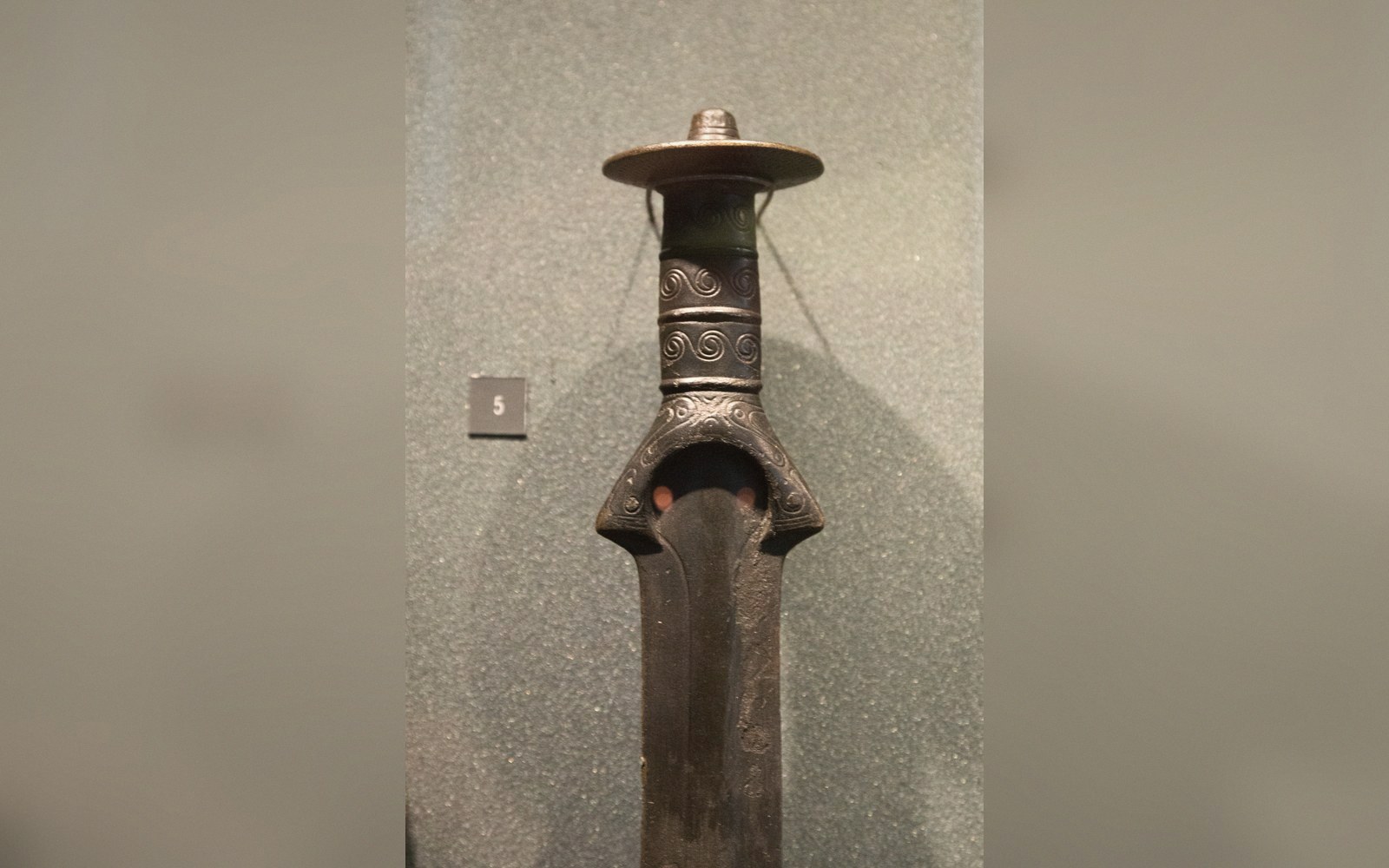
A blade on the bench before cleaning, corrosion intact. Most of what is known about typology was read off objects in this state.
Photo: Sword, Late Bronze Age, City of Prague Museum, 175563 · Wikimedia CommonsEvidence for finishing survives unevenly. Abrasives leave no mark on the metal record, only on petrological collections if anyone kept the used stones — which almost no one did. Hammer-work survives in the microstructure, readable by metallography. The tool marks of the files survive occasionally on incompletely finished objects or on decorative recesses that the abrasive could not reach. What finishing rarely survives is the final polish: organic residues, oil or tallow worked into the surface as a last step, are gone. The object we recover is always a partially stripped version of the object the smith delivered.