Work-hardening an Edge
Hammered cold, the edge gets harder — and eventually cracks.
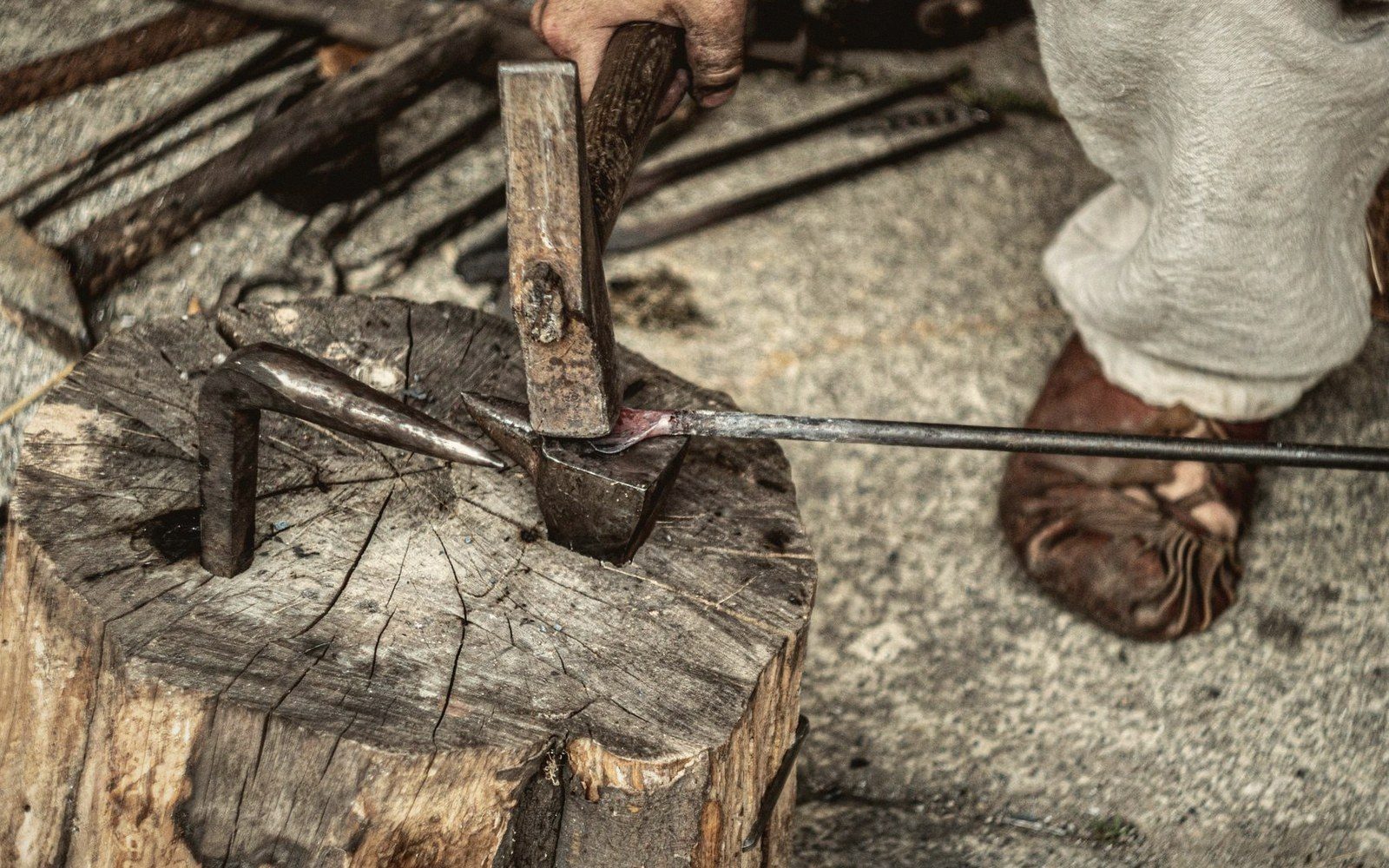
Cold work at the edge. The hardness that makes a blade usable is added after the casting, by hammer.
Photo: SHOX ART / PexelsCold hammer, harder metal — up to a point
Bronze cast from a mould is already a considerable achievement, but the edge that emerges from the mould is not the edge that goes to work. Finishing — grinding, filing, scraping — removes flash and refines the profile. Then the smith does something different: he hammers the blade cold.
What the evidence looks like
| Item | What the record says |
|---|---|
| Compressed, elongated grain structures visible under optical microscopy in edge cross-sections | |
| Hardness differentials measurable between edge zones and cast body of the same object | |
| EBSD (electron back-scatter diffraction) | technique used to map grain orientation and deformation in metal cross-sections |
The mechanism is metallurgical. Under a hammer blow, the crystal grains within the alloy deform and elongate, and dislocations within the metal's lattice multiply until they begin to obstruct one another. The metal resists further deformation, which is precisely the point — that resistance is hardness. On a well-cast sword blade or socketed axe, systematic cold-hammering along the cutting edge can raise surface hardness substantially relative to the cast interior, producing a blade with a tough, work-hardened outer zone over a somewhat softer, more ductile core. The alloy composition matters here: a tin content toward the higher end of the range — closer to the proportions described in discussions of proportion and hardness — responds more dramatically to working, because higher tin content gives a more brittle matrix that work-hardens faster.
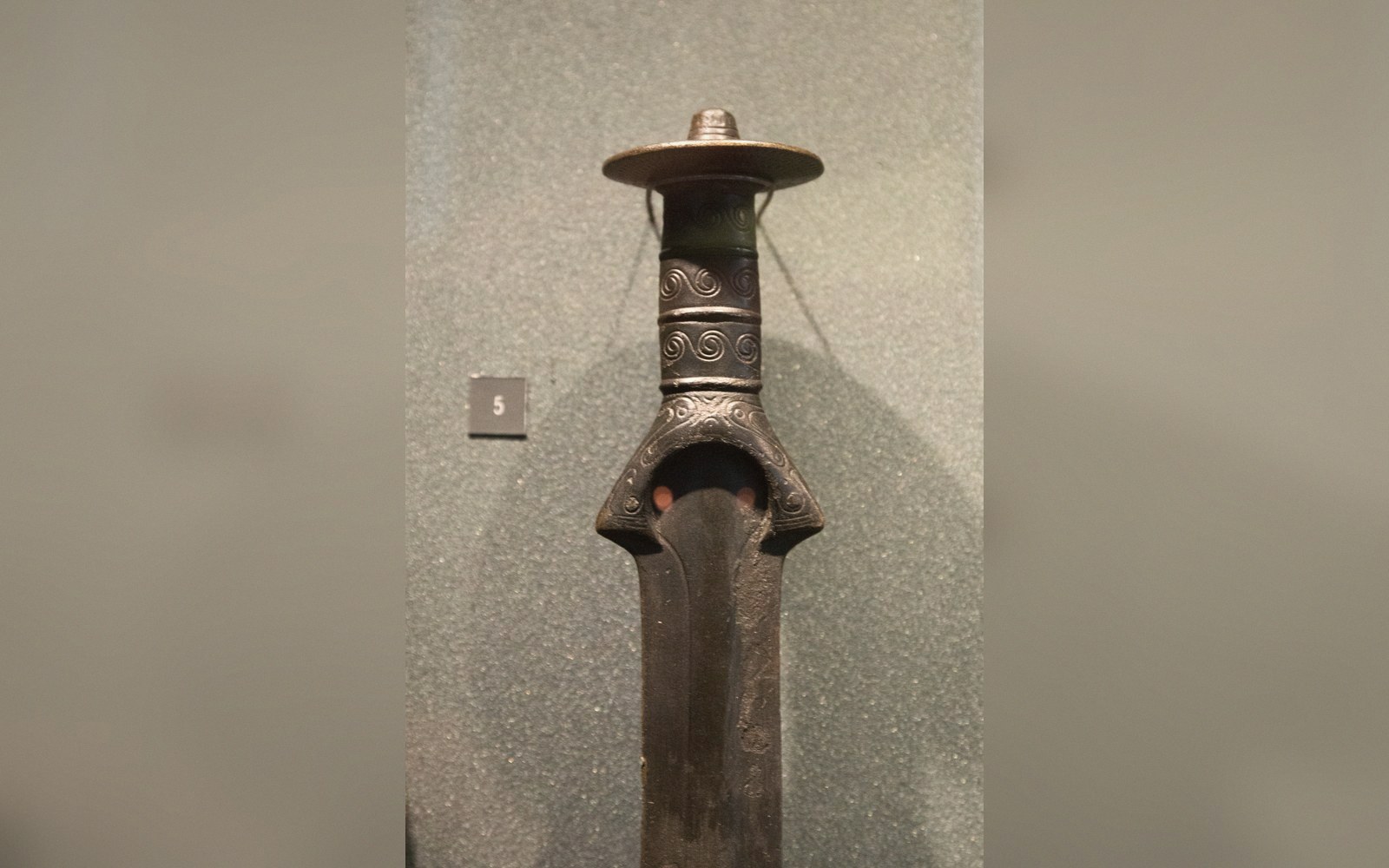
A blade on the bench before cleaning, corrosion intact. Most of what is known about typology was read off objects in this state.
Photo: Sword, Late Bronze Age, City of Prague Museum, 175563 · Wikimedia CommonsThe limit is fracture. Work the edge too far and the same dislocations that create hardness reach a density at which cracks initiate, propagating along grain boundaries. The smith navigates that threshold by feel, by sound, and almost certainly by long experience of particular alloy batches behaving in characteristic ways. When the metal begins to resist the hammer differently — a change in ring, a reluctance to move — the solution is annealing: heating the piece to a temperature that allows the deformed grain structure to recrystallise without melting, then allowing it to cool. The dislocations disperse, ductility returns, and the whole cycle can begin again.
The metallurgy in brief
| Item | What the record says |
|---|---|
| Work-hardening | repeated cold hammering deforms metal grains, multiplying dislocations that impede further movement and so raise hardness |
| Annealing | controlled reheating to allow grain recrystallisation, restoring ductility before the next round of working |
| Fracture threshold | the point at which dislocation density causes cracking rather than hardening; the practical limit of cold-working |
Modern metallurgical examination of Bronze Age cutting tools and weapons — using hardness testing, optical microscopy and electron back-scatter diffraction on cross-sections — has demonstrated this deliberate work-hardening repeatedly. Sword edges and axe bits show compressed grain structures that are absent in the cast body of the same object. This is not incidental; it is craft knowledge, embodied in practice and transmitted through apprenticeship. The smith did not need a theory of crystal lattices. The evidence that he knew exactly what he was doing is written into the metal itself.
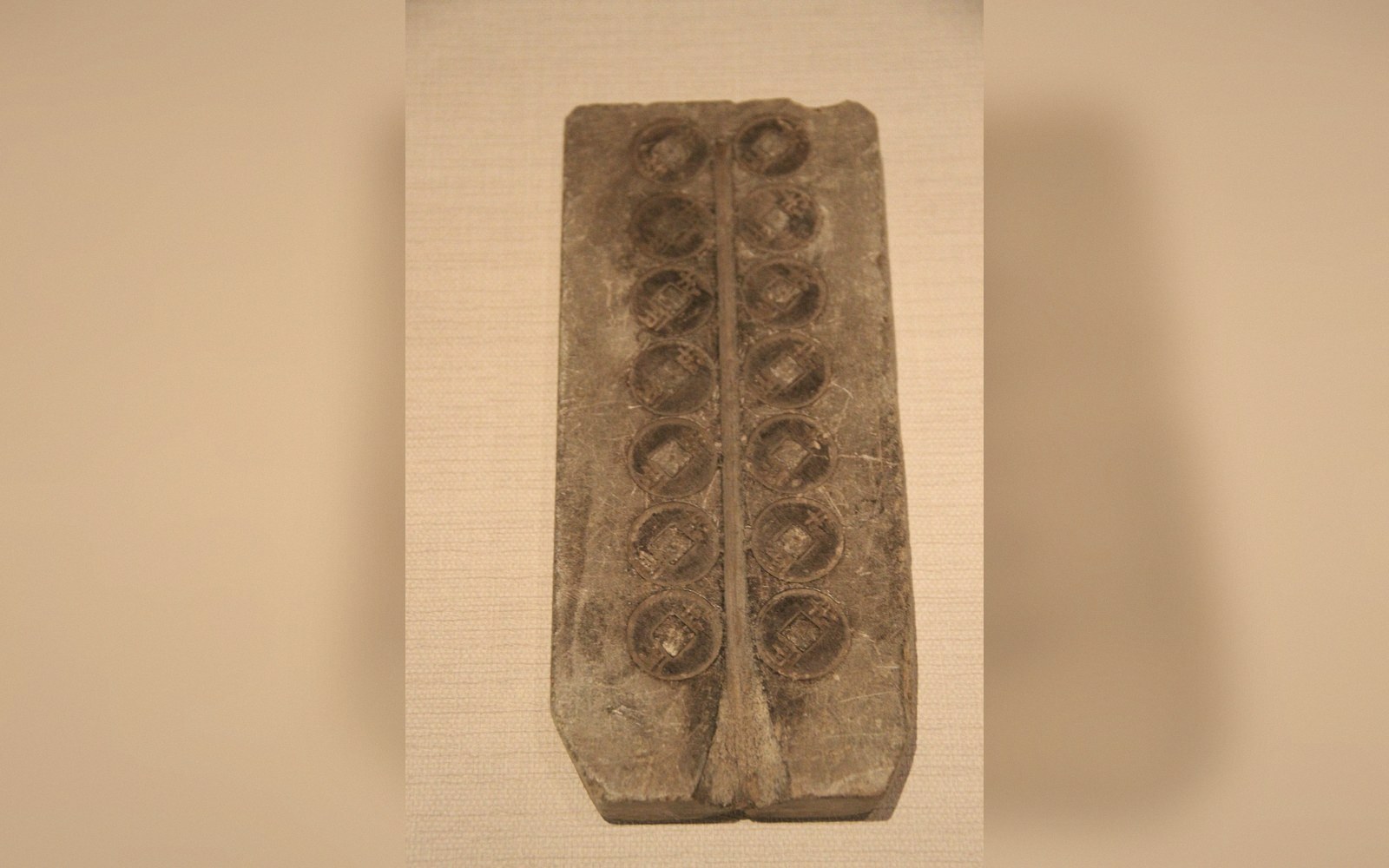
A stone mould: durable, reusable, and for that reason over-represented in the record compared with clay.
Photo: Stone Coin Mould 03 · Wikimedia CommonsThe corollary of that knowledge is maintenance. A chipped or dulled edge is not discarded — it is re-hammered, and eventually re-annealed. The object carries its biography in its metallurgy: successive working events, each leaving a trace that a modern laboratory can, with care, separate and read.